

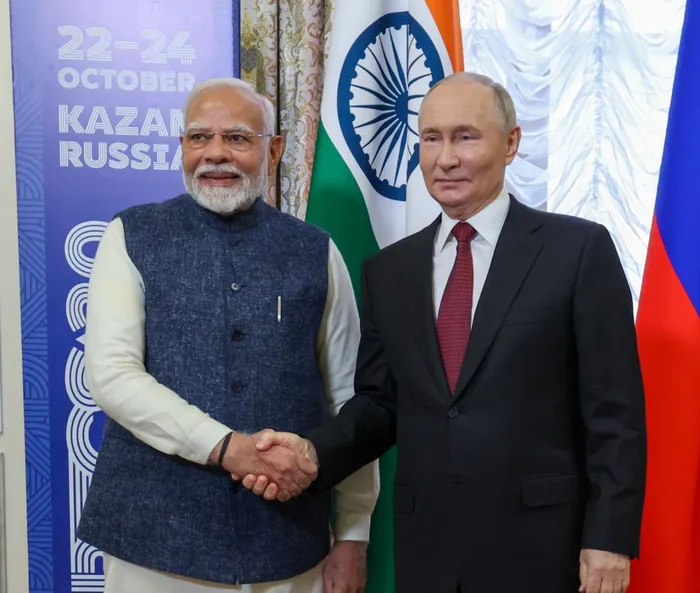
India-Russia relations are deeply rooted, according to Prime Minister Modi.
Image: Prime Minister Modi/X
THIS week in Moscow, over 1 250 business leaders and government officials from Russia and India convened for the XVI Russia-India Business Dialogue.
The gathering focused on expanding investment, developing financial instruments, and implementing joint projects. This forum followed the December bilateral meeting between President Vladimir Putin and Prime Minister Narendra Modi. These gatherings, however, do not signal simple diplomatic meetings; instead, they represent a critical attempt to stabilise a relationship under severe stress and strain.
Russia is currently a sanctioned state engaged in a protracted war in Ukraine, while India faces an explicit threat from the United States of 500% tariffs if it continues to buy Russian oil, alongside sustained diplomatic pressure from Western Europe rooted in profound tensions over Russia's expansion into Ukraine.
This precise convergence of war, economic coercion, and regional insecurity is what makes this one of the most fragile and consequential relationships in the world today. Understanding the fragility of this relationship requires examining what each nation is fundamentally trying to achieve and what it stands to lose.
For Russia, the partnership with India is a critical component of its strategy to remain a great power despite economic sanctions and international isolation designed to cripple its economy over time.
India, as one of the world’s largest and fastest-growing economies, provides a critical market for Russian hydrocarbons, particularly discounted crude oil. This trade-off is often conducted in national currencies, injects essential revenue and helps keep the Russian state fiscally afloat. India has become an economic lifeline for Russia.
But what is India’s endgame? Many pundits opine that Delhi’s approach is not about allegiance to the West or the East but about preserving its strategic autonomy and securing its national interest, but is this as simple as it appears?
India’s “resilient domestic market” is powerfully integrated with the West. The US and the European Union are its largest trading partners and the source of the critical investment, technology, and access to financial markets that fuel its growth.
The litany of American “Gigafactories” and supply chains abandoning China to leverage on India’s youthful population represents a once-in-a-generation opportunity for India to become the world’s next manufacturing hub.
Should India’s engagement with Russia trigger severe secondary Western sanctions or the withdrawal of crucial trade benefits, it could:
In essence, India risks derailing its central economic project at its most promising moment whose duality is anchored in the vision of, The Bharatiya Janata Party (BJP) which first came to national power in India in May 2014, when Prime Minister Narendra Modi was sworn in as Prime Minister which was, to turn India into a global economic superpower and to lift hundreds of millions of Indians out of absolute poverty in a generation.
Concurrently, India also has primary security/border challenges in its region, with its main strategic counterweight being the Quad partnership (US, Japan, Australia, India) and deepening defence ties with the US, France, and Japan.
These relationships provide intelligence, advanced arms, and indispensable security and diplomatic support. The informal, trust-based cohesion of the Quad could be damaged if members question India’s commitment to a “free and open Indo-Pacific” while it financially enables Russia’s war against the same principle in Europe.
Given these colossal risks, why does India persist with its relationship with Russia?
I can only speculate but for pundits in and across the Global South, the developments are worthy of being studied because few nations possess the scale, strategic heft, or domestic industrial base to take India’s posture.
The world watches this precarious manoeuvre to see if it will become a masterstroke of a rising power confidently setting its own terms, or the perilous overreach that ultimately leads to its demise.
Ultimately, as the world watches the Russia-India relationship to see if this balance of power bears fruit, the delicate geo-political complexities in Eurasia confirms that in a fractured world, ultimate power resides with those who possess a strong and strategic domestic foundation that comes from cohesion in policy, vision and implementation.
* Phapano Phasha is the chairperson of The Centre for Alternative Political and Economic Thought.
** The views expressed here do not reflect those of the Sunday Independent, IOL, or Independent Media.