

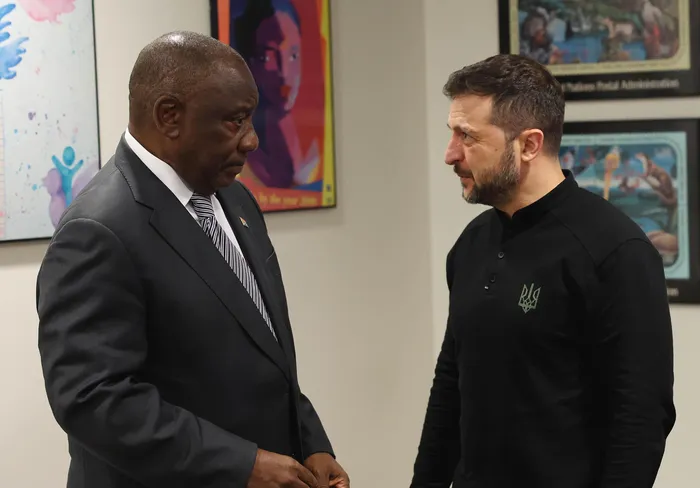
President Cyril Ramaphosa in a bilateral meeting with the President of Ukraine Volodymyr Zelensky on the margins of the 79th Session of the General Assembly in New York on September 25, 2024.
Image: Kopano Tlape/GCIS
Abbey Makoe
As most of the international community paused in “shock and awe” of the US whilst staging a brazen military attack on Venezuela – kidnapping and whisking away the country’s president and his wife to a detention centre far away in New York – some celebrated the cowboy drama as a lesson for adversaries.
Among the celebrants was Ukrainian President Volodymyr Zelensky. Since that ignominious scene inside the White House when the US President told Zelensky “you’ve got no cards“ to play in ending the war with Russia, the Ukrainian leader has been too careful never again to rub his US counterpart the wrong way. “Too eager to appease” appears to be his new posture toward Washington.
Soon after President Nicolas Maduro and his wife Cilia Flores were kidnapped, a jubilant Zelensky proposed that the Trump administration extend the same fate to the leader of the Russian Chechen Republic, Ramzan Kadyrov. Zelensky said such a move would send a strong message to the Russian President Vladimir Putin.
Said Zelensky: “The whole world can see the result. They did it quickly. Well, let them carry out some kind of operation against Kadyrov. Maybe then Putin will see this and think about it.”
For his part, Kadyrov hit back at Zelensky instantly, challenging the Ukrainian leader to “man up” and carry out the Venezuela-style kidnapping himself instead of hiding behind the back of the Americans.
It is understandable when a weaker leader kowtows to a stronger one. But at times, one wishes the likes of Zelensky would have rather kept quiet than needlessly embarrass himself in the arena of world politics.
Perhaps a deep sense of desperation can drive the most distressed leaders to levels of unimaginable self-harm. For, surely, Zelensky would have been better off silent than loud on an issue of such blatant transgression of international law, where Venezuela’s sovereignty was violated and territorial integrity undermined to no end by the belligerent Trump administration.
I presume that if they so wish, the Russians could nick Zelensky out of his Kiev palace effortlessly. He must therefore be careful of what he wishes unto others, for it may very well happen to him. That is why, at best, I’d argue that Zelensky should have elected to mimic his relentless European backers’ lukewarm posture in relation to the Venezuela issue. Evidently, Europe and the West were caught in a state of moral dilemma and geopolitical uncertainty of unprecedented proportions in recent history.
I raise this scenario to question South Africa’s wisdom in the choice of geopolitical allies. Last year, President Cyril Ramaphosa took many by surprise when he laid a red carpet for Zelensky, treating him with pomp and ceremony during a time when Pretoria’s non-aligned foreign policy stance attracted an avalanche of question marks.
President Ramaphosa would, of course, argue that he pursues efforts to broker peace with the Ukrainians in the same way he does with the Russians. However, the fact that the Russian President was not allowed to attend the BRICS Heads of State summit in Johannesburg in August 2023 remains proof of the regard Pretoria has for the Russian president. When juxtaposed with the royal treatment the Ramaphosa administration accorded Zelensky, the difference is stark and telling.
In addition, the unceremonious manner in which Zelensky cut short his state visit to SA is sore to this day. It all happened pretty much unexpectedly. An hour or so before the completion of the ceremonial frills, Zelensky was up and gone! He departed hurriedly, citing a Russian rocket attack on Kyiv as a reason for leaving. However, the rocket attack on Kyiv has been a daily occurrence since the outbreak of the war in October 2022. The excuse was, therefore, plain hollow.
Foreign policy honchos at the Department of International Relations and Cooperation (DIRCO) as well as the Presidency ought to know that they owe it to South Africans to select with great care with whom the country aligns, and why.
Until this day, I struggle, like many international relations practitioners, to find a persuasive reason behind Zelensky’s state visit to our shores, particularly at the precarious time that it happened, given the geopolitical sensitivities that abound, as well as SA’s strategic membership of BRICS, where there is proximity between Pretoria and Moscow.
Ukraine has sadly found itself caught in a spot of bother that is frosty relations between Russia and NATO. Since the fall of the Soviet Union at the turn of the 90’s, Russia had sought to hold NATO to its US-dispatched undertaking that NATO would not expand eastward to Russia’s doorstep.
When the promise was not kept, nay broken, Russia sought dialogue with NATO, without success. Particularly, former US President Joe Biden laughed off Russia’s concerns publicly, to the point of mocking Moscow. And when President Putin witnessed imminent NATO’s boots-on-the-ground in Ukraine, Russia’s next-door neighbour, which had grown aloof, that became the straw that broke the camel's back. As they say, the rest is history.
As for Pretoria, it is vitally crucial to play geopolitical cards carefully and sensitively. Perception in politics is everything. Inadvertently, South Africa could find herself in an invidious situation of being perceived to hunt with the hounds and run with the hares.
In that way, no one will trust us, friend and foe alike. We ought to be careful and wise, too. To President Ramaphosa, it is important to bear in mind: A man is judged by the company he keeps.
*Makoe is Founder and Editor-in-Chief: Global South Media Network (gsmn.co.za). Views expressed are personal.
** The views expressed do not necessarily reflect the opinions of IOL, Independent Media, or The African.