

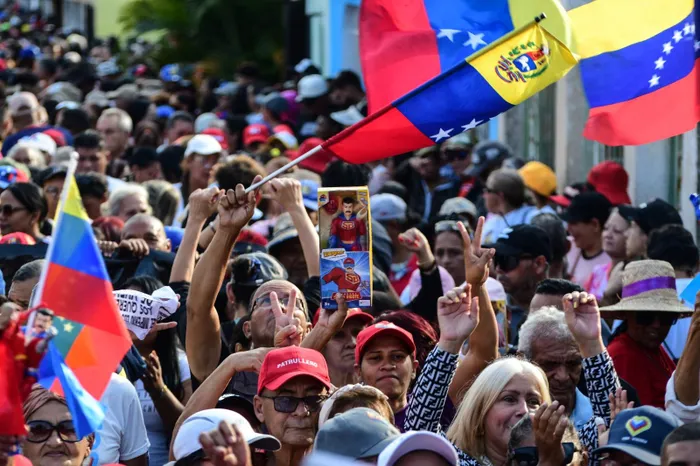
A demonstrator holds a toy of the caped superhero named "Super-Bigote" (Super-Mustache) during a rally in support of ousted Venezuela's President Nicolas Maduro in Valencia, Carabobo state, Venezuela, at the weekend.
Image: AFP
The story of Venezuela over the past two decades carries an important lesson for young South Africans. While some may debate the phrase “America’s capture of Venezuela,” what cannot be denied is that Venezuela has faced sustained external pressure through economic sanctions, political interference, and global media narratives largely shaped by powerful Western interests, especially the United States.
This experience should matter to young people in South Africa because it shows how quickly a country’s sovereignty can be weakened when foreign interests begin to shape its political and economic direction.
Sovereignty is more than having a flag, borders, or regular elections. It is about a nation’s ability to make decisions in the interests of its own people without being forced, punished, or manipulated by external powers. In Venezuela, sanctions restricted access to global markets, banking systems, and essential goods. These measures were often described as tools to promote democracy, yet ordinary Venezuelans suffered the most. Food shortages, rising prices, unemployment, and collapsing public services became part of daily life. The cost of foreign pressure was paid not by political elites, but by ordinary citizens.
Young South Africans should see this as a warning. South Africa is also rich in natural resources, including minerals, land, and energy potential. History shows that countries with valuable resources often attract foreign attention that is not always benevolent. Influence does not always come in the form of soldiers or war. It can arrive quietly through economic dependence, debt, corporate dominance, and political pressure.
Venezuela reminds us that a country can appear independent on paper while slowly losing real control over its future. One of the clearest lessons from Venezuela is the danger of economic dependence. Venezuela relied heavily on oil exports, leaving its economy vulnerable to external shocks and sanctions. When oil revenues declined and access to markets was restricted, the entire economy collapsed. South Africa risks a similar future if it continues to export raw materials while importing finished goods. Young people must push for industrial development, innovation, and skills training. Building a strong local economy is one of the strongest defences against foreign control.
Another important lesson is the role of internal division. Foreign powers often exploit existing political, racial, or class tensions. In Venezuela, deep political polarisation weakened national unity and made external interference easier. South Africa’s history of apartheid and ongoing inequality means similar divisions still exist. When young people are distracted by fighting each other, it becomes easier for powerful interests to operate in the background. Unity does not mean avoiding criticism or debate.
It means understanding that national disagreements should never be exploited to undermine the country itself. The Venezuelan experience also shows how powerful information and media narratives can be. International coverage of Venezuela often simplifies a complex situation, presenting foreign intervention as moral or humanitarian while ignoring its harmful consequences. Young South Africans must learn to question what they consume online and in the news. Media literacy is now a key part of defending sovereignty. Understanding who benefits from certain narratives helps people make informed decisions rather than emotional ones.
Perhaps the most important lesson is the role of young people themselves. Sovereignty is not defended by governments alone. It is protected by citizens who are informed, engaged, and willing to participate in shaping their country’s future. When young people withdraw from politics or believe their voices do not matter, they leave a vacuum that others are eager to fill. Voting, activism, community organising, and holding leaders accountable are not acts of rebellion. They are acts of responsibility. In the end, Venezuela’s experience is a reminder that sovereignty is fragile and must be actively protected. For young South Africans, the message is clear.
Economic independence, national unity, critical thinking, and active citizenship are essential. Defending South Africa’s sovereignty does not mean rejecting the world or isolating ourselves. It means engaging globally on our own terms and always placing the interests of our people first. If young people fail to learn this lesson, South Africa risks having its future shaped by forces that do not share its struggles, values, or dreams.