

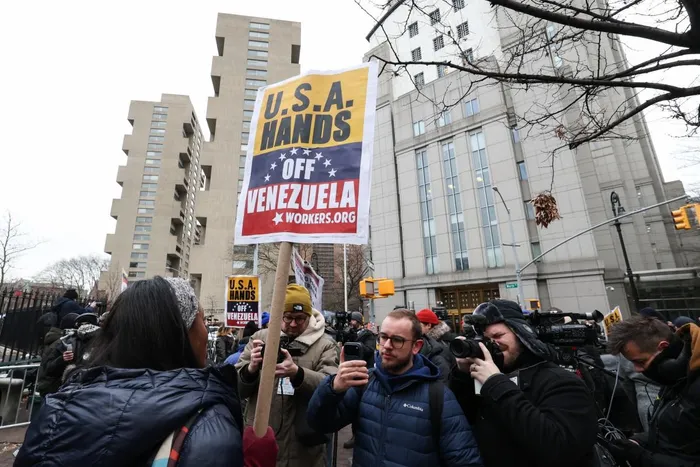
Demonstrators gather outside the Daniel Patrick Moynihan US Courthouse as ousted Venezuelan President Nicolas Maduro awaits his arraignment hearing. US special forces conducted a daring raid in Caracas, capturing Maduro and his wife Cilia Flores on narco-terrorism charges, followed by announcements of prolonged US oversight of Venezuela's vast oil reserves.
Image: Timothy A Clary / AFP
AS India assumes the BRICS presidency for 2026, the grouping gains renewed relevance at a moment when multilateral diplomacy faces its sternest test. The opening week of 2026 has seen a flurry of bold US foreign policy actions under President Donald Trump.
On January 3, US special forces conducted a daring raid in Caracas, capturing Venezuelan President Nicolás Maduro and his wife Cilia Flores on narco-terrorism charges, followed by announcements of prolonged US oversight of Venezuela's vast oil reserves. Just days earlier, on Christmas Day 2025, US strikes targeted alleged ISIS camps in northwest Nigeria’s Sokoto State, justified as protecting Nigerian Christians from terrorism.
Meanwhile, renewed threats to acquire Greenland, citing national security, rare earth minerals, and Arctic routes, have escalated tensions with Denmark, a NATO ally, with the White House not ruling out military options. Many nations in the Global South are searching for platforms that defend global norms.
These developments, unfolding rapidly, raise profound questions for the Global South.
Indian columnist TK Arun provides a compelling framework for understanding the current global shift. In prescient writings such as his December 31, 2025, Substack post “2026: Into the world according to Trump” and a subsequent analysis for The Core titled Trump’s Imperial Turn Leaves India With No Easy Choices, Arun characterises Trump’s foreign policy as a deliberate revival of 19th-century imperialism.
He draws a direct parallel to figures like President William McKinley, arguing that this approach actively dismantles the post-World War II rules-based order, a system built on treaties, sovereignty, and multilateralism. In its place, Arun contends, Trump is erecting a paradigm of transactional dominance where raw self-interest and resource extraction are paramount.
This thesis is crystallised in actions like the Venezuela intervention, which, though framed by Trump as a law-enforcement operation, ultimately resulted in US control over the nation’s oil exports, epitomising the new imperial logic.
Arun extends this critique to coercive economic tools, such as threats of up to 500% tariffs on nations buying Russian oil, forcing alignment or punishment. The Nigeria strikes, coordinated with local authorities but framed by Trump as a “Christmas present” to terrorists targeting Christians, risk expanding US footprints in Africa under anti-terror pretexts.
Greenland threats, Arun implies in his broader analysis of imperial resurgence, could also fracture alliances like NATO, treating sovereignty as negotiable when it suits US strategic needs.
Evaluating Arun’s insights against January 2026 realities: His warnings of imperial revival are strikingly validated. The Venezuela operation, while tactically successful in capturing Maduro (now facing trial in the US), has drawn bipartisan Senate efforts to curb Trump’s war powers.
Nigeria’s strikes killed multiple militants but sparked local debates on sovereignty and raised fears of broader African intrusion. Greenland rhetoric has prompted European solidarity with Denmark and warnings of NATO's potential crisis.
Another paradox has emerged for the Global South: Trump’s justifications, combating narco-terrorism in Venezuela, terrorism in Nigeria, and securing strategic assets in Greenland, seem compelling in regions plagued by corruption, instability, or external threats. In corrupt or failing states, decisive action by the US, promising order and accountability have tempted views of intervention as a “necessary reset”.
Arun counters this effectively, elucidating that such moves undermine sovereignty for all nations, setting dangerous precedents and destabilising the system that protects smaller states.
His core suggestion in his home country is that India should step forward to champion a rules-based global order, independently of waning US leadership. He argues that, as the world’s largest democracy with a tradition of strategic autonomy and non-alignment, India is uniquely positioned to lead this order.
This involves strengthening institutions like BRICS, building robust bilateral ties with Africa, Latin America, and other Global South regions, and transcending sectarian religious divides and class inequalities. This vision resonates with other Indian commentators, who advocate diversifying partnerships amid unreliable US policies and focusing on self-reliance to weather disruptions.
The early days of Trump’s second term have confronted the world with a stark conundrum in international diplomacy: how to uphold sovereignty and multilateral norms when a superpower increasingly acts unilaterally, justifying interventions with appeals to security, anti-corruption, and anti-terrorism while pursuing evident resource and strategic gains.
The Venezuela raid, the Nigeria strikes, and Greenland threats, all framed as necessary for global stability, illustrate this tension. Smaller nations, BRICS+ Nations and the Global South face a dilemma: condemn actions that erode the rules-based order, yet simultaneously grapple with the might of the US. In this age of Trump, diplomacy risks becoming transactional, where “might” overshadows multilateralism.
Africa, facing its own governance challenges, should prioritise internal reforms, anti-graft measures, and social cohesion to reduce vulnerabilities, inviting pretexts of invasion.
In this turbulent era, ethical and principled leadership are going to be essential. Arun’s call reminds us that survival demands not submission to might, but collective advocacy for norms that uphold human dignity and sovereignty for all.
* Phapano Phasha is the chairperson of The Centre for Alternative Political and Economic Thought.
** The views expressed here do not reflect those of the Sunday Independent, IOL, or Independent Media.