

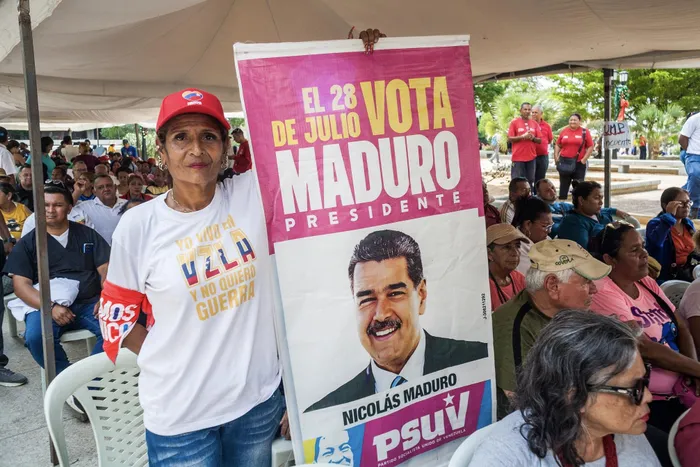
A supporter of ousted Venezuelan President Nicolas Maduro holds a banner during a demonstration as they watch a session of the National Assembly on a big screen in Maracaibo, Venezuela.
Image: AFP
A HUGE range of uncertainty has opened up in the wake of the US removal of Nicolás Maduro as Venezuela’s president.
At the time of writing, the US had allowed the rest of the Venezuelan government to remain in place, with Vice President Delcy Rodríguez now acting as President. US President Donald Trump has pledged further action should Rodríguez not act in the US’s interests.
The scale of the challenges ahead is vast. We estimate that GDP in 2025 was almost 70% below its 2013 peak. Under our simulations using our Global Economic Model, even a strong oil upside and 50% of emigrants returning leaves GDP 50% below the 2013 level in 10 years’ time.
Widespread improvements to the country’s institutions, education, and infrastructure are needed for a more complete economic recovery, alongside a stable security and political environment.
In the short term, oil output is likely to dip as the US blockade has limited diluent imports needed to process the country’s heavy oil blend and stopped some export tankers from reaching the country. This will clip our previous 4.2% year-on-year 2026 GDP growth forecast. Inflation, which we forecast to peak at almost 600% year-on-year this quarter, could rise even further if the government increases monetary financing in response to weaker oil revenues.
To help navigate near-term and longer-term uncertainties, we map out upside and downside possibilities under four key dimensions and their economic implications. These straddle hydrocarbons, internal security, a democratic transition and political stability, and rebuilding the state.
Even though Venezuela’s oil output, at close to 1mn bpd, is far below the 1990s peak of 3.5mn bpd, we estimate it still accounts for around 10% of GDP. The contribution of gas to the economy is smaller.
Considering Venezuela has the world’s largest proven oil reserves and that the assets of US oil firms were expropriated in 2007 under the previous presidency of Hugo Chávez, the hydrocarbon industry is plainly in the US’s sights in a post-Maduro Venezuela.
Upside possibilities: Future Venezuelan governments align with the US and international investment returns in droves to the country as sanctions are removed. Industry analysts point to easy wins with modest investment bringing significant output rises towards the 1.5-2mn bpd range over the next two years. From there, uncertainty widens, but estimates point to adding an extra 500k bpd to 2.5mn bpd over 10 years as possible, but at the cost of $15bn–$20bn. We take this as our strong oil upside scenario. Returning to the peak output of the 1990s would cost up to $100bn.
Downside possibilities: The new government rejects US demands and maintains Maduro's modus operandi. In economic terms, at worst, the oil embargo continues or is even broadened into a total goods blockade, Western oil firms don’t return, while non-Western actors hold back from dealing with the new government for fear of US retaliation. Oil output could lose the gains generated in recent years, with the slump taking the non-oil economy with it due to the government’s heavy dependency on oil revenues.
Prior US interventions have shown that a stable domestic security situation is a key factor for economic development following regime change: see Libya, Iraq, and Afghanistan. The armed forces in Venezuela have, for decades, been woven tightly into many facets of government and the economy, and top ranks are stacked with party loyalists. The loss of Maduro, therefore, puts the armed forces in a delicate position and drives the US’s decision to allow Vice President Rodriguez to assume power, rather than the de facto opposition leader Maria Machado.
Upside possibilities: At best, the armed forces remain loyal to whichever future governments assume power, with no rival militias or guerrillas emerging. Positive domestic security conditions alongside governance improvements attract broad-based investment and the return of a significant proportion of the almost 8mn Venezuelans who have left the country since 2014.
Downside possibilities: Even if it cooperates with the US, the new Venezuelan government could lose control of the armed forces and militias, with domestic security deteriorating. Guerrilla warfare or civil war could ensue. Costs of operating in the country rise, thereby holding back investment, exports, and the return of migrants.
The focus of international pressure will likely soon turn to future elections in Venezuela. However, we don't expect a democratic transition soon, given the loyalty of the armed forces to the current regime and their history of oppressing opposition political forces.
Upside possibilities: A stable political outlook (whether democratic or not) provides certainty to investors, boosting any economic recovery. A democratic transition is not a requirement for an economic upturn, given the role that higher oil revenues could play. However, we think the inherent alignment of interests of a democratically-elected government with those of the population makes a longer-term and broader-based economic recovery unlikely without a democratic system being established.
Downside possibilities: If elections are allowed, decades of governmental mismanagement could prevent the country from finding a stable political footing, with power flipping between competing factions. Investment in the hydrocarbon sector and other industries could fail to recover due to a lack of stability, and most migrants may never return. Widespread corruption and poor policymaking continue, limiting a wider economic recovery. Alternatively, the US may allow the current government to remain in power as long as hydrocarbon concessions are granted to US corporations and already-limited drug flows are stemmed. In this case, migrant returns would be minor due to an economic recovery capped in non-hydrocarbon sectors and higher chances of human rights abuses under undemocratic rule.
The state’s policymaking abilities have been hollowed out by decades of mismanagement, degrading the country's institutions and infrastructure. Rebuilding the state, improving policymaking capabilities, and rooting out corruption will be key to improving the country's long-term fortunes.
Upside possibilities: A best-case upside sees an international effort to rebuild the Venezuelan state, generating a broad-based economic recovery alongside the return of most migrants. This would be more likely under a democratic transition, but we think such an outcome is unlikely. Even so, if political power remains with Chavistas, US pressure could improve policy quality and reduce corruption. The economic recovery gains pace as infrastructure and educational opportunities improve.
Downside possibilities: Either under the current Chavista government or the end of such authoritarian rule, the hollowing out of institutions and policymaking capabilities may prove too severe to recover from. The country may become stuck in a vicious cycle of ingrained corruption and poor-quality policymaking, which rewards vested interests and stymies any economic recovery.
We see a stable, US-loyal government in Venezuela with an at least a minor economic recovery and improved domestic security as being most in line with US interests: this is the strongest path to increasing oil production by US firms, stemming the minor flow of drugs from the country to the US, encouraging as many of the approximately 1mn Venezuelans in the US to return home, and save any remaining face against international condemnation of US actions. We place a high weight on this scenario in the short term, as US intervention has so far focused on transition to a leader loyal to the US who has the armed forces' support.
Notably, US interests are not necessarily aligned with the strongest economic recovery for Venezuela. This will require decades of work to rebuild the state’s capacity, reduce corruption, improve policymaking and likely require a democratic transition. These outcomes are at odds with the interests of the armed forces, and so we place a low probability on a longer-term, broader economic recovery. A critical juncture for the armed forces will come if elections take place.
Perhaps the most inspiring example the US may try to emulate would be that of Panama, whose GDP per capita has more than tripled since the 1989 US invasion which likewise removed an authoritarian ruler.
However, Venezuela’s state and infrastructure are much more degraded than those of Panama following its own US intervention. This makes the challenges even more daunting and holds back recovery prospects for Venezuela.
We see a likely scenario of modest economic improvements in the next one to two years as a US-backed Chavista government opens up hydrocarbon investment and maintains domestic security, with some limited migrant returns.
But a broader long-term recovery is unlikely, as we think the current government will remain in charge because the entrenched position and interests of the armed forces make it difficult to transition to an opposition government. This will hold back the much-needed reforms that would boost Venezuela's long-term economic prospects.
* Tim Hunter is a senior LatAm economist at Oxford Economics.
** The views expressed here do not reflect those of the Sunday Independent, Independent Media, or IOL.