

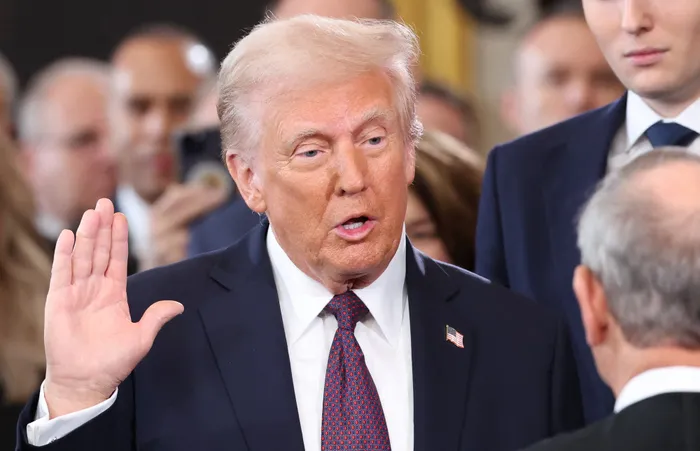
The $11.1 billion sale of a massive package of advanced weaponry for Taiwan is the second since US President Donald Trump returned to power in January.
Image: Kevin Lamarque / AFP
IF actions indeed speak louder than words, this week’s decision by the US to approve a record weapons sale to Taiwan is proof that the Trump administration is doing everything in its military power to trigger a confrontation with China.
The $11.1 billion sale (R186bn) of a massive package of advanced weaponry for Taiwan was greenlighted by Pete Hegseth’s Department of War and is the second since US President Donald Trump returned to power in January. The first was a $330 million deal for parts and components in November.
Predictably, China has taken umbrage at the move, correctly highlighting that under international law, and recognised by the UN, Taiwan is an integral part of China under the One-China Policy.
On October 25, 1971, the UN General Assembly adopted Resolution 2758, titled *Restoration of the lawful rights of the People’s Republic of China in the United Nations*.
The bulk majority of the international community, including the US, Russia and BRICS member states, recognises the One-China Policy as voted overwhelmingly through Resolution 2758. For example, in Africa, the only nation that does not adhere to the One-China Policy is the Kingdom of Eswatini (formerly Swaziland).
The international appreciation of Resolution 2758 states that Taiwan is an inalienable part of China and that the People’s Republic of China is the sole legal government representing the whole of China, including the self-governing territory of Taiwan.
It is this loophole in the autonomy of Taiwan that China’s geopolitical adversaries have sought to exploit over the years. The decision by the US to foster closer ties with Taiwan, including heavily arming the island, is part of Washington’s strategy to checkmate Beijing.
The separatists in office in Taiwan are fully aware of the loophole and have used their self-governing status to undermine mainland China’s national interest. Through it all, Beijing continues to push for a peaceful reunification with Taiwan, with no bloodshed, in recognition that all are one people who belong to one China. However, if the separatists in Taiwan were to fall for the temptation to ill-advisedly declare independence, China has reserved its right to unleash a military intervention.
This week’s US approval of more weaponry to Taiwan has left Beijing seething with anger. Responding to the developments, a spokesperson for the Chinese Foreign Ministry, Guo Jiakun, said: “China urges the United States to abide by the One-China Principle… and immediately stop the dangerous actions of arming Taiwan.” Beijing further argued that the US actions amounted to an infringement on China’s sovereignty.
The US-Taiwan deal will be implemented in about eight separate stages. The weapons delivery stages, according to details released by both governments, include the purchase of 82 HIMARS rocket systems and 40 ATACMS missiles valued at more than $4bn. The US will further deliver anti-tank and anti-armour missiles, loitering munitions and howitzers, military software, as well as spare parts.
Now, China’s meteoric rise in international affairs has posed a singular major challenge to the US-led Western hegemony since the end of WWII in 1945. China’s rise in military capabilities has accompanied the country’s economic expansion to a level where it is now officially the world’s second-largest economy, behind that of the US.
Additionally, China in the latter part of the 21st century has been marked by the simultaneous upliftment of the rest of the Global South, or Majority World, in world politics. The unfolding reconfiguration of the international world order that blatantly challenges Western domination and the US Empire has been quietly led by China without much noise.
The mobilisation of the Majority World through cooperation marked by initiatives such as the Shanghai Cooperation Organisation (SCO) and BRICS poses a major threat to the status quo, much to the expressed disapproval of Washington.
Furthermore, China’s much-hailed Road and Belt Initiative (RBI) has seen Beijing invest massively in infrastructural development projects across Africa in particular, triggering detractors to coin a mischievous narrative that China is “re-colonising Africa”. Yet the RBI is part of China’s foreign policy key objective, premised on the notion of collective growth and shared future, where no one is left behind in abject poverty and hardship.
It has therefore been crystal clear that China is located at the centre of the remaking of the international community. China is also a catalyst for solidarity in the Majority World, where the previously muted voice of the developing nations has grown more audible under China’s leadership role.
It is such dynamics that seem to have irked the powers-that-be in Washington. Aligning with Taiwan, therefore, can be viewed as a strategy to get back at China and de-focus the country from the pursuit of its geopolitical goals and stay focused domestically.
As a nuclear power, it is inconceivable to imagine China bowing to military threats from foreign powers. Beijing’s official policy is non-interference in the domestic affairs of others. It is in this light that President Xi Jinping and his Communist Party of China have been tremendously angered by the surreptitious interference in China’s internal affairs through sheer manipulation of the authorities in Taipei.
China’s rise in world affairs is both unstoppable and irreversible. It is a pillar upon which the rest of the Global South leans for shared development and security. It is difficult to work out the extent to which the US would be prepared to defend Taiwan in case the situation gets out of hand, and Beijing has to restore order.
The activities of Washington in Taiwan are clearly provocative and aimed at destabilising China. In case of any conflict, methinks the US will likely only provide weaponry, and not boots on the ground, as WWI (1914-1918) and WWII (1939-1945) showed.
Tango with Taiwan is merely a strategy of destabilisation and disruption. China is a relevant and main target of such a strategy. No single nation poses a threat to the US domination as China does today. It is a conundrum the US is willing to throw back at China, and Taiwan is simply a low-hanging fruit in the greater scheme of things.
It is a dangerous game that the US is playing. It is a gamble. It is an act of high-risk taking with frightening consequences imaginable. Cooperation with China instead of tariffs or military wars will serve the US and the world much better in a safer space of peaceful coexistence. The Taiwan issue was resolved by the UN in 1971. It requires cool heads, not hot heads.
* Abbey Makoe is Founder and Editor-in-Chief: Global South Media Network (gsmn.co.za). Views expressed are wholly personal.
** The views expressed here do not reflect those of the Sunday Independent, Independent Media, or IOL.