

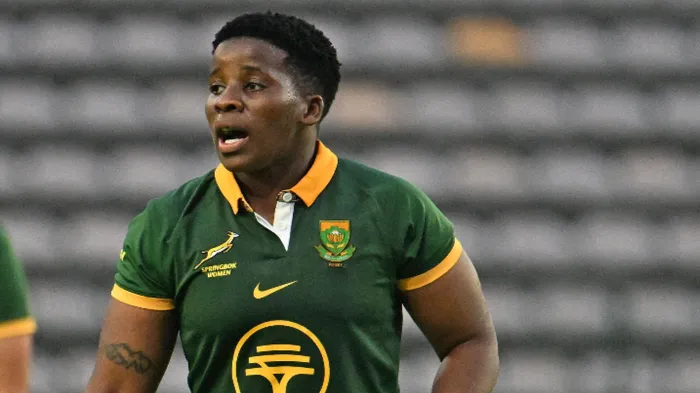
Springbok legend Lusanda Dumke was a titan of the turf, earning 33 Test caps and leading the Bulls Daisies to three consecutive Women’s Premier Division titles through 2025. Yet, her true contribution to our society cannot be captured by the 10 international tries she scored or the trophies she hoisted.
Image: BACKPAGEPIX
WHEN Nelson Mandela spoke the following words, he was describing a force capable of bridging the deepest chasms of our unequal society. “Sport has the power to change the world. It has the power to inspire. It has the power to unite people in a way that little else does. Sport can create hope where once there was only despair.”
In the life and career of the Springbok legend Lusanda Dumke, we saw those Mandela’s words made flesh. Dumke’s journey from the grassroots fields of the Eastern Cape to the captaincy of the Springbok Women was more than a sports story; it was a masterclass in defiance against systemic odds and a profound contribution to the very fabric of South African leadership.
Dumke was a titan of the turf, earning 33 Test caps and leading the Bulls Daisies to three consecutive Women’s Premier Division titles through 2025. Yet, her true contribution to our society cannot be captured by the 10 international tries she scored or the trophies she hoisted. Her impact lay in the visibility she demanded for women in a space that had long ignored them. In a country where the playing field remains notoriously tilted, Dumke’s career was a living refusal to wait for permission.
We often celebrate the finished product — the captain in the green and gold — without acknowledging the grit required to emerge from a landscape that offers so little. Like thousands of young athletes across the Global South, from the rural stretches of Limpopo to the unpaved clearings of the Eastern Cape, Dumke’s journey began in the gaps.
In these spaces, the spirit of the game burns brightly even when the floodlights don’t exist. Her rise to the 2025 championship was a victory over the "systems of invisibility" that usually swallow talent whole. She didn't just play for those watching in the stadiums; she played for the girl standing on a patch of dry grass in a remote "dorpie," proving that a lack of infrastructure does not mean a lack of destiny.
In South Africa, the neglect of sport is often written into the landscape itself. We see the crumbling fields in our townships and the rise of private, boutique wellness spaces in our suburbs — a privatisation of fitness that leaves the majority of our children with nowhere to play. In this context, Dumke was a revolutionary. By rising through a sport that still struggles for equitable support, she became a symbol of what is possible when we refuse to let infrastructure define our ambition.
Her career also offered a silent but powerful critique of our modern obsession with the privatisation of fitness. While we have normalised exclusive, expensive boutique gyms and private wellness spaces, Dumke’s life was an embodiment of the communal ethos. Rugby is a game of contact, of holding the line, of collective struggle.
In an unequal society, her presence reminded us that health and movement should not be commodities for the few but a right for the many. She reclaimed the idea of the "active lifestyle" as being exclusive to the elite and brought it back to the community, showing that true sporting culture is built on public tracks and accessible grounds, not behind guarded buildings and membership paywalls.
In a society where Black women are too often asked to shrink their presence, Dumke’s leadership was an act of expansion. As she anchored her country in international tests and guided the Daisies to their historic 2025 championship, she wasn't just winning games—she was normalising the idea of the professional female leader in the South African consciousness. She understood that in an unequal society, excellence is a political statement.
Every time she wore the green and gold, she sent a message to every girl in a rural “dorpie” or a crowded township: your talent is valid, your leadership is necessary, and your ambition belongs in the light. Her legendary “golden heart” was especially evident around three years ago when, at the Eastern Cape Sports Awards, where she was awarded a car but famously turned it down, pleading with the government to instead build her family a house — a poignant example of a leader who always put her community first.
This is where the transformative power of sport truly resides. It is not merely about recreation; it is about the “unseen” talent that burns in places the cameras rarely reach. Dumke’s legacy forces us to confront the fact that while the world invests in e-sports and drone racing, our youth are still fighting for the most basic structures to channel their talent. Her life serves as a blueprint for a new social contract — one where we move beyond the privatisation of health and return to a communal ethos of movement and collaboration.
When we honour Lusanda Dumke, we are honouring a vision of gender empowerment that goes beyond slogans. She proved that empowerment is built when women are trusted with responsibility and when their leadership is recognised not as an exception, but as a given. She showed us that when we invest in women, the influence radiates far beyond the stadium walls, strengthening community ties, improving public health, and fostering mutual growth.
We must recognise that Dumke’s leadership was an exercise in Ubuntu/botho — the understanding that her success was inextricably linked to the progress of the collective. She understood that empowerment isn’t only about breaking ceilings, but about ensuring the floor is raised for everyone else. Whether she was guiding young forwards in a provincial training session or anchoring her country in an international test, she was building a school of teamwork and discipline.
As we conclude 2025, we do so with heavy hearts. We must realise that the fight for equity is not abstract. It is lived every day by those who, like Dumke, refuse to defer their dreams. If we are serious about the "unity" Mandela spoke of, we must revamp the fields, fund the teams, and tell the stories of the women who are shaping our future in real time.
Lusanda Dumke’s legacy is a living principle. It is the belief that when women are given the space to lead, our entire society benefits. She has left us with a challenge: to ensure that the path she carved out with such grit and grace becomes a highway for the many who will follow. Her story is our reminder that sport can indeed change the world—but only if we have the courage to invest in the people who carry that change on their shoulders.
Rest well Dumke. Rest in eternal power and rise in glory.
* Tswelopele Makoe is a gender and social justice activist and editor at Global South Media Network. She is a researcher, columnist, and an Andrew W Mellon scholar at the Desmond Tutu Centre for Religion and Social Justice, UWC.
** The views expressed here do not reflect those of the Sunday Independent, IOL, or Independent Media.