

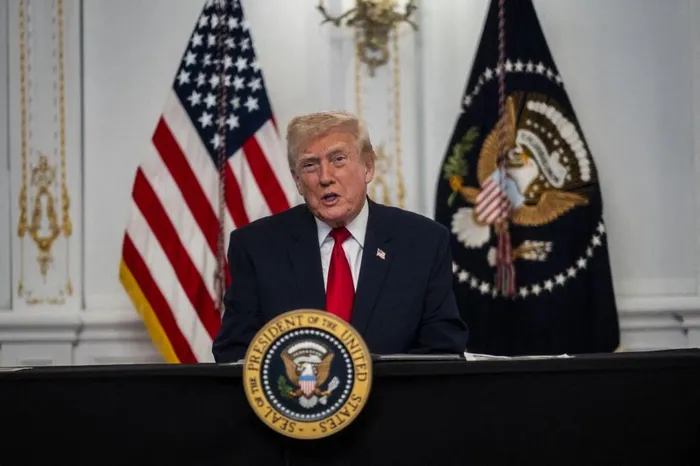
In a sarcastic jab, former US Department of Defense official Michael Rubin suggested that US President Donald Trump deserves a Nobel for uniting India and Russia through failed diplomacy, including punitive tariffs on Indian goods and a bullying approach that alienated a key ally.
Image: Pete Marovich/Getty Images/AFP
FORMER United States Department of Defense official Michael Rubin, a seasoned expert on Middle Eastern and South Asian affairs, recently delivered a scathing assessment of US policy toward India, particularly in the context of its energy dealings with Russia.
In comments made amid Russian President Vladimir Putin’s visit to India in early December 2025, Rubin accused the US of outright hypocrisy. “We are being hypocritical when we lecture India,” he said, pointing out that while Washington criticises New Delhi for purchasing discounted Russian oil, the US itself continues to engage in trade with Moscow, including indirect energy imports when it suits its needs.
In a sarcastic jab, Rubin suggested that Trump “deserves a Nobel” for uniting India and Russia through failed diplomacy, including punitive tariffs on Indian goods and a bullying approach that alienated a key ally. He emphasised that the US owed India a “vocal apology” for its double standards, warning that such policies not only erode trust but also push India toward diversifying its partnerships away from US reliance.
Rubin’s critique underscores a fundamental flaw in US exceptionalism: the assumption that the US can dictate terms without reciprocity, which ultimately weakens its global position. Rubin’s observations frame a larger question about US President Donald Trump’s approach to India, which he deems as one of the US’s most vital allies and the world’s fastest-growing major economy.
As US diplomatic experts like Rubin tear into Trump’s weakening of US statecraft, a critical question emerges: What truly drives his hostile stance toward a pivotal ally like India? Analysis reveals it is not a simple miscalculation, but a potent blend of misinformation, ignorance, and deliberate bullying; a pattern that extends far beyond New Delhi.
This approach is rooted in misinformation, filtering the complex US-India strategic partnership through a reductive, transactional lens. It is amplified by willful ignorance, a disregard for the sovereignty and strategic imperatives of nations, a trait starkly visible in derogatory rhetoric toward African, Latin American, and other Global South nations.
Ultimately, it is operationalised as a calculated bullying tactic, a performance of dominance designed to create diplomatic chaos from which to extract unilateral concessions.
Together, this triad forms a colonial-minded transactionalism. It views nations not as partners but as vessels for resources or deals. For India, this hypocrisy is a glaring signal: under such capricious pressure, diversifying partnerships, potentially drawing closer to Russia or navigating a more complex stance with China, becomes a strategic necessity.
The paradox is fatal. Trump’s “America First” bluster, intended to project strength, systematically dismantles the alliance-based influence built over decades. It accelerates the very multipolar world it claims to oppose, leaving the US increasingly isolated as partners like India, the world’s fastest-growing major economy, are pushed to secure their futures elsewhere.
Under the guise of “America First”, this policy risks creating an “America Alone” scenario, unravelling the intricate web of alliances painstakingly constructed by US presidents from Harry Truman to Ronald Reagan. Truman’s era, marked by the establishment of NATO and the Marshall Plan, exemplified how shared institutions and mutual benefits could amplify US power.
In contrast, Trump’s transactional worldview treats allies as subordinates, demanding concessions without offering sustainable alternatives. As Rubin notes, this has accelerated India's pivot toward Russia, evident in Putin’s recent Delhi visit, where discussions on energy, defence, and multipolar cooperation took centre stage.
At the heart of this issue lies a glaring double standard that undermines US credibility. The US’s Indo-Pacific strategy hinges on India as the democratic bulwark against radicalism and expansionism. From safeguarding vital sea lanes in the Indian Ocean to bolstering Taiwan’s security through frameworks like the Quad (comprising the US, India, Japan, and Australia), robust partnerships are essential.
Yet, by pressuring India over its legitimate energy needs, driven by affordability and supply reliability, Trump's administration overlooks these realities.
This hypocrisy, as Rubin articulates, stems from a failure to empathise with India’s position. New Delhi faces soaring energy demands amid its economic surge, and Russian oil, often acquired at discounted rates, helps stabilise prices without compromising sovereignty. Meanwhile, the US has not hesitated to import Russian uranium or fertilisers when domestic shortages arise, revealing a “do as I say, not as I do” mentality.
Such inconsistencies erode soft power, the intangible influence that has long been the US’s greatest asset.
The paradox is stark: policies meant to project strength instead foster isolation. Rubin’s point about Trump's incompetence fostering India-Russia ties is borne out in recent developments. Bilateral trade between India and Russia has skyrocketed since 2022, reaching over $65 billion (R1.1 trillion) in 2024, with energy comprising the bulk.
Defence collaborations, including joint production of advanced weaponry, have deepened, partly as a hedge against US unpredictability. When the US positions itself as an unreliable partner, nations like India naturally seek multi-alignment, balancing relations with Russia for energy, the US for technology, and Africa for minerals.
India’s response is emblematic of its diplomatic prowess under Indian Prime Minister Narendra Modi: Prioritise national interest above all, which the world has been observing with awe. Guided by a doctrine of strategic autonomy, New Delhi engages the world on its terms, refusing to be coerced into binary choices.
Trump’s threats, whether through tariffs on steel and aluminium during his first term or renewed rhetoric on trade imbalances, only reinforce this pragmatism. As Rubin warns, without offering competitive alternatives, the US risks diminishing its leverage, compelling India to fortify ties elsewhere.
The contrast with historical US leadership is illuminating. Truman and his successors understood alliances as force multipliers, investing in partners’ prosperity to secure long-term loyalty. The Marshall Plan rebuilt Europe not out of altruism but strategic foresight, creating a bloc resilient to “communist” influence.
Reagan's engagement with emerging democracies such as China similarly expanded American spheres. Trump’s model, however, views allies as “freeloaders”, a shortsighted perspective that chips away at trust. Upon leaving office, the US could inherit a tarnished reputation, with partners wary of policy whiplash. Rebuilding this will demand time, resources, and a shift toward consistency, challenges compounded by visible proofs of hostility toward even steadfast allies like India.
The lesson embedded in Rubin’s critique is profound: genuine leadership transcends bullying and double standards. It demands setting a consistent example, fostering mutual benefits, and embracing strategic empathy, understanding partners' constraints and aspirations. the US’s zenith of influence coincided with visions of shared security and prosperity, not isolationist dominance. The “America First” paradox illustrates that attempting to subjugate all leads to leading none.
For India, the trajectory as projections reflect has been unambiguous: harness its demographic dividend, technological prowess, and economic momentum to ascend as a global power, engaging all actors on equal footing. Recent summits, like Putin's visit, affirm this multipolar approach, yielding deals in nuclear energy, defence, and space that bolster self-reliance.
For the US, reclaiming centrality requires introspection. As Rubin advocates, acknowledging hypocrisy and extending apologies could mend fences. Prioritising reliable energy alternatives, deepening tech collaborations, and respecting India’s autonomy would fortify the partnership.
Failure to adapt risks a realigned world order, where multipolarity thrives without US preeminence. In this evolving geopolitical chessboard, the US must choose: evolve into a collaborative leader or fade into irrelevance.
From an African perspective, as explored by our Centre for Alternative Political and Economic Thought, India’s experience offers valuable lessons for the continent. African nations, navigating their own great-power dynamics, can draw from New Delhi’s multi-alignment strategy to assert strategic autonomy, diversify partnerships, and prioritise national interests amid global pressures, ensuring resilience in an increasingly multipolar world.
* Phapano Phasha is the chairperson of The Centre for Alternative Political and Economic Thought.
** The views expressed here do not reflect those of the Sunday Independent, IOL, or Independent Media.