

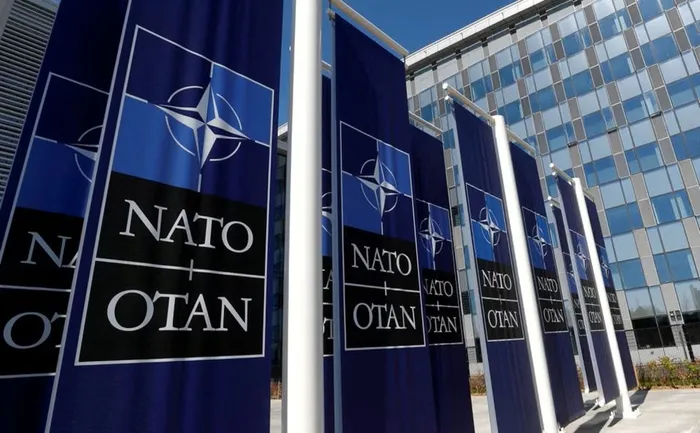
The NATO peace prize of 2025 went to President Vjosa Osmani of Kosovo. The horror is not so much in the fact that Osmani was the recipient, but that Europe’s war machine has a Peace Prize, or whatever long and fancy style it goes by.
Image: Yves Herman / Reuters
IT is not difficult to calculate the number of wars President Donald J. Trump claims to have negotiated into a state of peace. Eight, to be exact, according to the enigmatic president. What the actual number is to be sure, is a function of perspective.
Preferably, the recitation of each one of them could be to analyse them chronologically. Or, where the counting should start is, as the verses of the Good Book command, right from the beginning. Oddly, it could not be said with certainty that the order of resolving each conflict followed any chronology, or the determination of the age of the conflict, at least not to the extent that the older the conflict ranked in time, the first it would enjoy pride of place.
President Donald J Trump came into office, touted as a peace candidate. He reasoned without being unreasonable that if he could resolve a good number of these conflicts, he could claim the ultimate peace accolade of all time.
All he had to do was choose from a panoply of conflicts which the United States has itself surreptitiously instigated or tends to perpetuate in pursuance of the agenda of a unipolar strategy.
Of the touted legend of eight, there are some conflicts which are more prominent than others without any pronounced order of priority. And if he can pull it off, notwithstanding the spirited resistance by Volodymir Zelenskyy and the Coalition of the Willing, President Donald J Trump may resolve the NATO proxy war in Ukraine against Russia and bag his coveted ninth.
The prism that introduces gradations of gravity and global importance to each conflict and the idiosyncrasies of each of their varied circumstances misses an important vantage about the unipolar hegemon. Every conflict, every war and pretty much every developing crisis collectively have intrinsic in them, the indelible fingerprint, if not the overbearing steering of the US from the dark penumbra of subterfuge and manipulation. So that by design, every conflict ineluctably plays into the complex pages of the hegemon’s complex agenda.
The punted Serbia-Kosovo conflict, whose intensity of brewing is said to have been solved at its highest point of acceleration, is on the list as an exception to its peers for a few reasons. History has it that for the expansion of NATO eastwards, a section of Serbia had to be bombed and carved out, just to create a non-entity called Kosovo. Thereat, a forward NATO war base in Eastern Europe.
With respect to a conflict prevented between Egypt and Ethiopia, it is hitherto uncertain how such a looming war was prevented. Aside from the fact that Egypt is Africa’s largest recipient of US military aid, approximating $2 billion annually, there was no grand setting where Egypt and Ethiopia were in attendance and signed off on a peace agreement.
However, as facts would have it, Washington has always been on the side of Egypt in trying to prevent Ethiopia from constructing the Grand Ethiopia Renaissance Dam. And second, they equally tried with commitment in preventing Ethiopia from commissioning the dam without making some unintelligible concessions to Egypt. This is a strange inclusion indeed in the list of wars resolved by the grandiloquent US President.
There is a matter of what stopped the India-Pakistan conflict. The belligerents in that conflict have, for predictable reasons, different versions of the considerations that accounted for the temporary cessation of hostilities. And the general account is not helped by the fact that Donald J. Trump insists that he facilitated the ordering of the ceasefire, temporary or otherwise, which India strenuously remonstrates against.
The making up of the list of the so-called wars that have either been stopped or prevented from happening, and the qualification criteria of entry, are perplexing. For one, do the wars that Donald J Trump started on his own accord and suddenly stopped in like manner qualify to make it to this list? He encouraged Israel to launch a bombing campaign and decapitation strikes against Iran. He then followed it up with US bombing raids on Iranian nuclear sites.
In the ensuing tit-for-tat bombing, which bruised Iran to be sure, but more significantly, devastated Israel’s infrastructure and forever pierced its halo of invincibility, a very intense military engagement indeed, President Donald J Trump suddenly announced that the war was over. Not a peace agreement.
Not a settlement of the issues that triggered the war in the first place. As if inspired by the ring around the 1967 Six-Day War catchphrase and its brevity, the US president boisterously called this unprovoked attack on Iran the Twelve-Day War.
As mentioned earlier, in every modern conflict post the Second World War, if indeed modernity is shorthand for all the barbarism post Second World War, the hand of the US is writ large. Until recently, it took a significantly long period of time to discern with certainty what the role of the US had been, making almost every analysis merely conspiratorial. Commencing with Clinton to Bush Jr to Obama to Donald J Trump to Joe Biden, and somewhat bizarrely, to Donald J. Trump again, the US had no need to hide its hand in any conflict whatsoever.
In this context, the Rwanda-DRC crisis presents a unique perspective of covert military support, intelligence sharing and financial subvention. Whilst the DRC had strong leanings for support from the Russian Federation, Rwanda has been receiving financial aid from the US for a variety of reasons, including military, at least according to reports of 2021. Certainly, President Kagame’s military training at the United States Army Command and General Staff College in Fort Leavenworth, Kansas, would come in good stead.
The US, for its part, leveraging its relationship with Rwanda, brought significant power behind that country, a small economy managing a $14 billion GDP for its survival, yet displaying an oversized military ambition as it does. Seeking to counter the influence of the Russians in the world’s most mineral-rich country in the world, the US deep state did what it does best. They pressured the DRC militarily through their vassal just so it would agree to terms that would favour Washington.
At every turn, however, Rwanda tries to controvert the narrative that they have alliances with anyone, including the widely held continental conviction that Kigali is underwriting the training, intelligence gathering, including logistics and ordnance cover for the M-23 rebels. Someday, some records held somewhere in Washington DC under the protection of national security, shall truly reveal the theatrical directors of one of the most brutal conflicts in the African continent.
There is a developing pattern which is as intriguing as it is worrying. Few of these so-called peace constructs have disturbing patterns of recidivism. The Thailand and Cambodia peace accord was signed to great fanfare in Kuala Lumpur. Arguably, or at least according to the peripatetic Donald, the fear of tariffs from the United States persuaded them to sue for peace. A few days ago, the bombing campaign between these countries commenced sporadically along the border regions, claiming human fatalities and property damage.
There is also Gaza, the high mark of the true architecture of these peace agreements. The United Nations Security Council was invited to vote on the US-sponsored peace deal between Israel and Palestine. The vote was carried to a resolution only because there was no veto against it. The Chinese and Russians did not oppose it. They preferred an abstention. So many displaced Palestinians rejoiced at this development and started flocking back to their homesteads, ostensibly to rebuild their lives afresh. Israel has commenced bombing them again.
M23 is at it again, capturing more villages and butchering more innocent civilians in the process. Israel is said to be preparing to attack Iran again.
It is not clear what changed the minds of the custodians of the Alfred Nobel Trust. The Peace Prize used to reward the efforts of those who promote peace in the world, and not those who propagate for the military invasion of their country's regime by other countries or actively seek to start wars.
Maria Colina Machado, long considered a Mossad /CIA asset and the most spirited war monger in Latin America, has received the Nobel Peace Prize. Trump, another dangerous war monger, got the FIFA Peace Prize, whatever that means.
And horror of horrors, the NATO peace prize of 2025 went to President Vjosa Osmani of Kosovo. The horror is not so much in the fact that Osmani was the recipient, but that Europe’s war machine has a Peace Prize, or whatever long and fancy style it goes by.
* Amb. Bheki Gila is a Barrister-at-Law.
** The views expressed here do not reflect those of the Sunday Independent, Independent Media, or IOL.