

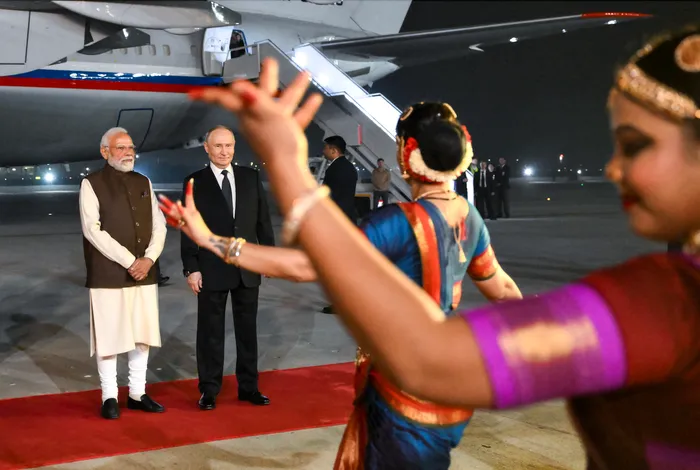
Russian President Vladimir Putin is welcomed by Indian Prime Minister Narendra Modi upon the Russian leader's arrival at Palam Air Force Base in New Delhi on the first day of his two-day state visit to India.
Image: Grigory Sysoyev / AFP
IN a visibly divided international world order, cut down the middle between the Global North and Global South, Indian Prime Minister Narendra Modi has nailed his country’s colours to the mast by brazenly defying the West and hosting Russian President Vladimir Putin on a state visit.
It is a stance India has not taken lightly. To defy the US and EU combined requires balls of steel. The gradual but certain decline of Western hegemony has seen the Global North lose its stranglehold on the international governance system.
The renaissance of the Majority World, better known as the Global South, has used the twilight of the 21st century to dare challenge Western dominance of the globe.
This week’s very public embrace of Putin in the rarefied atmosphere of New Delhi at the invitation of Modi has left the West reeling in disbelief and downright disdain. The tables have turned. Modi has drawn the line in the sand. Modi’s expression of independence of thought and freedom of choice is a microcosm of the Global South’s unstoppable rise like a phoenix.
Surely, there will be consequences looming on the horizon for India. But India’s sovereignty is clearly not up for sale. National interest has precipitated the Modi administration to make a bold choice. It is a bed Modi has made. He surely must now lie in it.
As for Putin, his state visit to India is tantamount to shoving a middle finger at his plethora of detractors in the West. From the minute he landed at the Palam Air Force Base, Putin basked in the glory of an undying friendship with India. Relentless attempts by the collective West to collapse his country’s economy have fallen flat, and efforts to isolate him internationally have gone the same way, as Modi has proven.
India, a regional and global power of note, has, in hosting Putin, notably poured scorn on the warrant of arrest issued by the controversial International Criminal Court (ICC). India’s act of defiance — electing to choose a figure widely detested in the West and thereby risking becoming part of the potential collateral damage — can be regarded as a turning point in the reconfiguration of the international governance system and international relations.
It sets the stage for the nations of the Majority World to hitherto assert their rights, pursue their national interest without fear and reclaim their seats at the world table where they have so many times been only on the menu of former colonial and imperial powers.
At a glance, and had international diplomacy been stable and predictable, Putin’s state visit to India would have simply passed as an act of allies strengthening bilateral ties. However, our reality in the current state of geopolitics points to a litany of ramifications likely to stem from Putin’s pomp and ceremony in India, feted by Modi, a man the West had regarded as a strong ally until recent times, notably since the outbreak of the Russia-Ukraine conflict.
Led by the Biden-era White House, the West — including the EU and NATO — has imposed an unprecedented barrage of economic sanctions against Moscow, sanctions that have proved ineffective since they were unleashed in 2022. The West has strenuously sought to isolate Russia internationally, persuading as well as surreptitiously coercing, in particular, the Global South nations to join in their questionable Russophobia.
However, led by China, the Majority World flatly rejected the Western stance against Russia, opting instead to exercise its own sovereign rights individually and collectively. As Europe upped the ante against Russia, drastically reducing purchasing of traditionally inexpensive gas and oil from neighbouring Russia, sanctions began to feel suicidal as they bit the hands that set them off.
Europe opted to turn to the US for oil and gas, purchased at astronomical sums of money and taking much longer to be delivered due to the distance marked by oceans between Europe and the US.
In the same streak of resetting and redirecting relations, the West sought to prevail on India — a perceived ally — to boycott Russian oil, gas and other goods too. The alarming challenges amid the rapidly changing global relations were marked, in my humble opinion, by India’s drastic increment in appetite to trade with Russia as the West looked elsewhere.
The more the West attempted to dissuade the Modi administration from cooperating with Russia since 2022, the more India’s appetite for Russian goods and services became insatiable. This week, Modi described Putin as “my friend”. Furthermore, writing on his X-account, Modi said relations between India and Russia are time-tested and bring great benefits to the peoples of both countries.
Quite clearly, therefore, Putin’s state visit has proven that relentless attempts to drive a wedge between Moscow and New Delhi have failed. Russian oil and gas keep flowing to India, trading in national currencies as part of BRICS de-dollarisation. In fact, more than 90% of mutual trade between Russia and India is carried out in national currencies.
The two countries have a large-scale plan for more cooperation in the future, including in technology, space, and nuclear energy, according to Putin’s remarks in India. Russia and India are key and founding members of the BRICS bloc, an anti-thesis of Western-led G7.
Putin’s trip to India was watched across the world. In Egypt, the trip was described as a “strategic move that could shake up the international chessboard”.
Since 2022, India has joined China as Russia’s biggest trading partner. As the Ukraine conflict dragged on, and the antagonism of the West toward Moscow multiplied, hawks across the West began to urge US President Donald Trump to target all nations that buy, especially Russian oil.
China was regarded as incorrigible. India, traditionally boasting cordial relations with the West, was regarded as a relatively soft target to be persuaded to walk away from trade with Russia. The Trump administration accused India of bankrolling Russian war machinery in Ukraine by buying Russian oil. This is the conundrum of the moment, the headache of the times in international relations.
The stance of India, and the apparently obstinate stance of New Delhi to retain warmer and warmer bilateral relations with a nation the West sought to turn into a pariah, has caused the EU and Washington not a headache, but a migraine.
India’s cosy ties with Russia reflect a spanner in the works for Western hegemony. At a population of about 1.46 billion, according to Statista, India is the world’s most populous nation. It is followed by its strategic ally, China, at 1.41 billion. Together, India and China account for a whopping 35% of the world’s population.
This is why this week’s Putin’s state visit to India matters significantly. It happens at a time when China stands on the verge of overtaking the US as the world’s biggest economy. To have India choosing Russia as a strategic ally over the US and the West is certainly a game-changer in global affairs. It causes a serious realignment of relations, as well as reassessment.
At the core of it all, India’s open ties with Russia affirms the Kremlin’s undying influence in international relations, particularly in the Majority World.
* Abbey Makoe is Founder and Editor-in-Chief: Global South Media Network (gsmn.co.za). Views expressed are wholly personal.
** The views expressed here do not reflect those of the Sunday Independent, Independent Media, or IOL.