

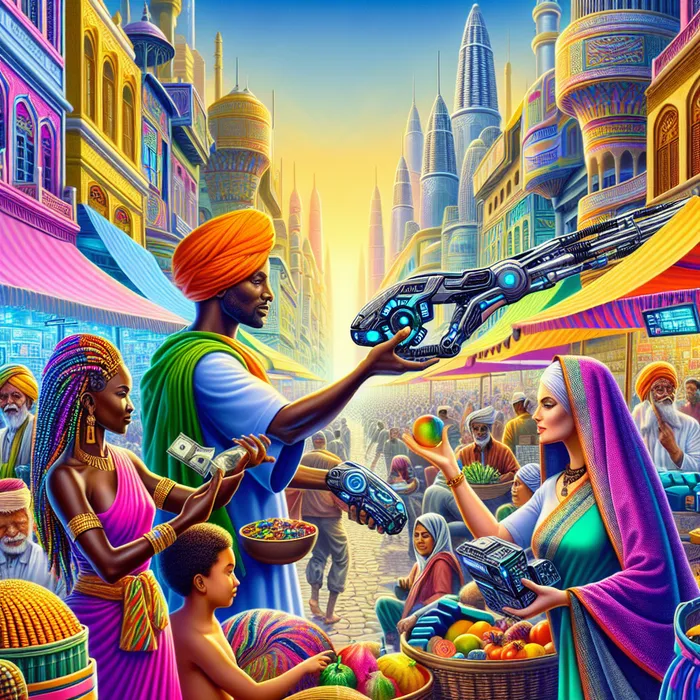
INDIA’S engagement with Africa has deepened sharply over the past two decades, clearly making the continent a central pillar of India’s foreign and economic policy.
Image: Ron AI / Sunday Independent
INDIA’S engagement with Africa has deepened sharply over the past two decades, clearly making the continent a central pillar of India’s foreign and economic policy.
Built on historical solidarity and complementary strengths between Africa’s resource-rich economies and India’s expanding industrial and technological capabilities, the partnership has grown into one of the most dynamic in the Global South.
India is now Africa’s third-largest trading partner, with bilateral trade exceeding $80 billion in 2024/25, driven by energy, minerals, pharmaceuticals, automobiles, agriculture, and the rapid spread of digital technologies.
India and Africa share a deepening economic partnership anchored in trade, investment and development cooperation. India’s cumulative investments in Africa stand at $75bn, reflecting its long-term commitment to the region.
The relationship continues to strengthen across sectors such as agriculture, pharmaceuticals, digital technologies and infrastructure, positioning both regions for sustained growth and collaboration.
India and South Africa also enjoy one of the most profound and emotionally anchored partnerships anywhere in the Global South, shaped by shared struggles, civilisational links, and political solidarity.
The relationship traces its roots to Mahatma Gandhi’s transformative years in South Africa, where he launched the Satyagraha movement in 1893, giving rise to a philosophy that influenced both India’s freedom struggle and South Africa’s fight against apartheid.
India-South Africa diplomatic relations were restored in 1993/94, marking a new era of partnership that soon culminated in the Red Fort Declaration of 1997, establishing South Africa as India’s first strategic partner.
Since then, cooperation has expanded across political, defence, economic, scientific, and cultural domains, supported by the vibrant Indian-origin community of 1.7 million people in South Africa. High-level visits, frequent ministerial meetings, maritime cooperation, and cultural exchanges continue to reinforce the strength of this historic bond.
India has been one of the strongest advocates for expanding the voice of the Global South within global decision-making institutions, and its support for South Africa’s enhanced role in the G20 has been both principled and strategic.
During India’s G20 Presidency in 2023, India played a pivotal role in ensuring that the African Union was admitted as a permanent member of the G20, thereby transforming the grouping into a more representative platform. South Africa, being Africa’s most industrialised economy and political influencer, has long been regarded by India as the natural voice of the continent.
India’s diplomatic efforts in championing Africa’s representation reflected the shared belief that global economic governance should mirror contemporary economic realities rather than outdated post–war structures.
This collaboration is strengthened by their work together in BRICS, IBSA, and the Indian Ocean Rim Association, where they consistently advocate inclusive development, climate justice, sustainable growth, and financial equity.
Trade between India and South Africa has grown steadily over the past decade, reflecting expanding economic complementarities and deeper integration of supply chains. The period from 2019/20 to 2023/24 demonstrates robust growth, with total trade rising from $11.07bn to $19.25bn despite global disruptions caused by the Covid-19 pandemic, supply chain fragmentation, and geopolitical uncertainties.
India’s exports to South Africa include pharmaceuticals, automobiles, engineering goods, chemicals, textiles, rice, and gems, while its imports are dominated by gold, coal, copper, manganese ore, phosphoric acid, and minerals essential for India’s manufacturing and renewable energy sectors.
South Africa remains one of India’s largest sources of gold and a major partner in critical minerals, making it strategically important for India’s industrial value chains. The bilateral trade structure is strong, diversified, and poised for expansion under AfCFTA, which provides new opportunities for tariff rationalisation and regional market access.
With India’s rising economic capacity and South Africa’s strategic position in African regional blocs, the trade partnership is projected to cross $25bn in the next few years, making it one of the most vibrant trade corridors in the Global South.
Investment flows between India and South Africa also reflect a partnership that extends well beyond trade, anchored in business confidence and long-term strategic value. Indian investment in South Africa is estimated to exceed $10bn, led by sectors such as automotive manufacturing, pharmaceuticals, IT services, mining, banking, and logistics.
Conversely, South African investments in India, exceeding $5bn, span technology, finance, insurance, energy, FMCG, retail, and chemicals. The balanced nature of investment flows demonstrates deep mutual trust, strong policy alignment, and the presence of stable institutional frameworks on both sides.
As global supply chains diversify and new opportunities emerge in renewable energy, digital technology, and critical minerals, the India–South Africa investment corridor is expected to expand substantially over the coming decade.
The future of India–South Africa relations is poised to be even more transformative as both nations pivot towards emerging sectors such as digital ecosystems, renewable energy, critical minerals, high-technology manufacturing, and maritime security. South Africa possesses some of the world’s most crucial mineral reserves, including platinum group metals, manganese, and vanadium, all of which are vital for India’s green hydrogen, electric vehicle, solar, and semiconductor industries.
India’s digital public infrastructure model, anchored in UPI, Aadhaar-like systems, and digital payments, is being explored by South Africa for interoperability, digital government, and financial inclusion. Vaccine manufacturing, biotech innovation, and affordable healthcare remain promising areas of collaboration, given India’s leadership in pharmaceuticals and South Africa’s scientific capabilities.
Defence co-production and maritime cooperation are expected to strengthen under shared Indian Ocean security objectives. With AfCFTA creating a single African market, South Africa can serve as the gateway for Indian companies into continental supply chains, while India can help South Africa scale new-age industries through technology, investment, and skilled manpower. The next decade is thus set to redefine the partnership along strategic, economic, and technological dimensions.
India and South Africa stand today as two of the most important partners in the Global South, united by history, strengthened by economic complementarity, and guided by a shared vision of a fairer and more inclusive world.
Their bilateral relations, built over a century of solidarity and reinforced by strategic engagement across political, economic, defence, scientific, and cultural domains, is now entering a new phase defined by technology, sustainability, and global leadership.
India’s support for Africa’s growing role in global governance, particularly in the G20, reflects its commitment to empowering developing nations. South Africa, with its industrial capacity and continental influence, is a natural collaborator as both nations work to build resilient supply chains, expand renewable energy partnerships, deepen digital and fintech cooperation, and foster innovation-driven growth.
The India–South Africa partnership is not merely an economic or diplomatic engagement; it is a long-term civilisational alliance with immense potential to shape the future of South–South cooperation. As both countries step into an era of global leadership, their partnership is poised to endure for centuries, driving prosperity, equity, and shared progress across India, Africa, and the World.
* Phapano Phasha is the chairperson of The Centre for Alternative Political and Economic Thought.
** The views expressed here do not reflect those of the Sunday Independent, IOL, or Independent Media.