

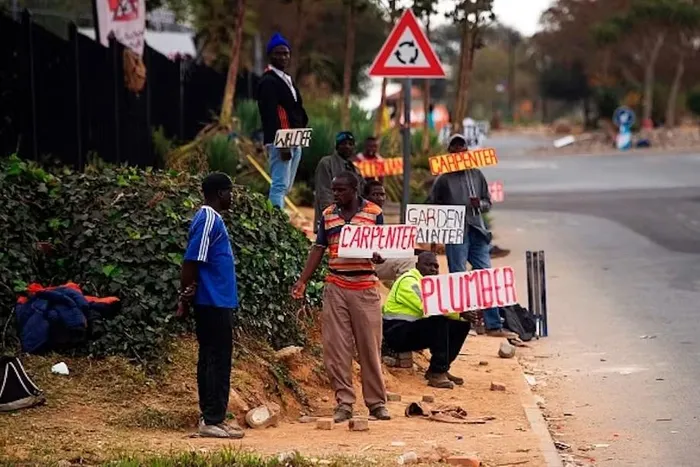
Job seekers wait on the side of a road holding placards advertising their specialisation. Millions of people in our nation have been scouring for jobs for decades, and more have abandoned careers entirely to widen their chances of employment.
Image: Mujahid Safodien/AFP
JUST last week, Statistics South Africa (StatsSA) finally offered the nation a glimmer of relief with news that our notorious unemployment rate had dipped.
The report stated that the official unemployment rate had dropped to 31.9% in the third quarter of 2025, with 248 000 people gaining employment.
This has been an uncommonly positive sign for our country, considering that the scourge of unemployment has haunted South Africa for decades. Although this report indicates progress, it’s vital that we read beyond the figures.
The report uncovers a deeper challenge.
Millions of people in our nation have been scouring for jobs for decades. Millions more have abandoned careers entirely to widen their chances of employment. Debates about the types of jobs and gaining employment raise questions about whether our employment statistics truly reflect the state of the nation.
Why do youth (age 15–34) still face crippling unemployment, despite these new stats? And why did the unemployment rate in the Eastern Cape rise, instead of dropping alongside the rest of the country, with a loss of 53 000 jobs in just three months?
Regardless of future trajectories, these statistics must be viewed as a blueprint for preparing for our future. Construction, community services, and trade sectors saw the highest influxes, employing a total of 354 000 people. Meanwhile, manufacturing, finance, and utilities saw the largest losses, with 146 000 jobs lost.
At a glance, these figures suggest an upward trajectory for our employment crisis. But across the nation, jobs aren’t simply disappearing — they’re being reshaped and redirected by technology at a pace we are failing to prepare for.
In our globalised, highly technological society, the impact of automation is deeply felt. Technology is often seen as a tool of empowerment, taking on tasks that would otherwise fall to humans. Across sectors, functions, and systems are increasingly digitised. From tech-driven innovations in trade and construction to automation in finance and manufacturing, technology is a double-edged sword. The onus is on us to ensure that technological developments cater to the unique needs of our society.
Technological developments are affecting the lived realities of all South Africans. From AI to automated delivery systems, society has become increasingly integrated into the digital world. Jobs do not vanish into thin air — they shift, evolve, or are redefined entirely.
The latest report makes one thing clear: Not all jobs are created equal, and not all disappear. They transform. From agriculture to retail to public services, the roles being lost are increasingly those being automated. Yet new roles — in digital maintenance, data processing, clean-tech, and community-centred innovation — require a different partnership between people and machines.
This isn’t about technology taking jobs; it’s about the gaps that emerge when tech races ahead of public planning, skills development, and social inclusion. To ensure technology works for us rather than against us, it must be integrated deliberately, equitably, and sustainably — with those most affected at the centre of its design and deployment.
In the past, tech has been problematised for its lack of accessibility. South Africa, the most unequal society in the world, shows that economic inequality is a sharp determinant of one’s access to tech tools and devices, without bridging the infrastructural and skills gap, automation and AI risk deepening unemployment, particularly for underprivileged communities.
Additionally, half of the population (women) remains disproportionately affected by unemployment, especially in youth demographics and informal sectors. Technology will continue to impact jobs traditionally held by women, such as retail, admin, and social services, affecting female-led households, which constitute almost 43% of all homes in South Africa.
Currently, the digital economy is extremely unequal. Rural areas, marginalised communities, women, youth, and people with disabilities are frequently left behind, even as new sectors emerge. When technology is people-centred, it doesn’t just churn out efficiency — it becomes a catalyst for real change. Designed with the environment, communities, and everyday realities in mind, tech can build new industries, ignite innovation, and force collaboration where it’s needed most.
Training, resources, and equitable access to digital technologies are critical. Clean energy projects can create local jobs, digital platforms can empower small businesses, and data-driven solutions can reshape healthcare and education for underprivileged communities. This is technology that works with people, not against them. It becomes a tool to empower, connect, and transform society.
It is our collective responsibility to actively shape the role of technology. Digital tools are abundant, but they remain futile and exclusionary if they do not center the needs of everyday South Africans.
As one powerful quote from the fiction universe reminds us: “The machines we build must serve the dreams of humanity, not the other way around. Our creations must enlarge our lives, give us more time, more capacity … Otherwise, they are just obstacles.”
* Tswelopele Makoe is a gender and social justice activist and editor at Global South Media Network. She is a researcher, columnist, and an Andrew W Mellon scholar at the Desmond Tutu Centre for Religion and Social Justice, UWC.
** The views expressed here do not reflect those of the Sunday Independent, IOL, or Independent Media.