

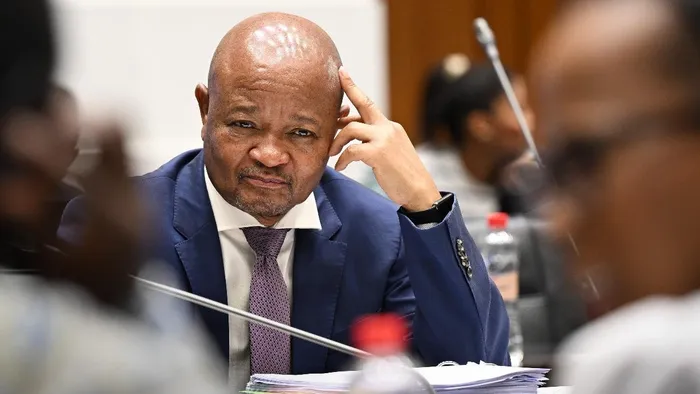
The recent tension between suspended Police Minister Senzo Mchunu and his chief of staff, Cedrick Nkabinde, is not a technical dispute.
Image: Henk Kruger / Independent Media
IN South Africa’s public administration, the concept of truth has become elastic, stretched, reshaped, and often conveniently redefined.
The recent tension between suspended Police Minister Senzo Mchunu and his chief of staff, Cedrick Nkabinde, is not a technical dispute. It is a mirror reflecting the fragility of our governance system and how easily political power can bend procedure until the very foundations of accountability crack.
Mchunu, the appointing authority, told Parliament’s ad hoc committee that interviews were conducted before Nkabinde’s appointment. This statement was meant to affirm that due process was followed. Yet in his testimony, Nkabinde claimed that government guidelines did not require interviews for his position.
Now, the ad hoc committee is left to determine a fundamental question: Was the appointment of the chief of staff properly conducted, or has due process once again become a casualty of political convenience?
At first glance, it may seem like an administrative mix-up, best left for Human Resources manuals. But this small contradiction reveals something larger, a public service where accountability depends on interpretation, not rules; on discretion, not transparency.
If Nkabinde is correct, then Mchunu’s testimony misrepresented the process. If Mchunu is correct, his chief of staff may have been appointed outside proper procedure. Either way, one of the state’s most senior offices has miscommunicated or misled Parliament, and that is the heart of the problem.
This is not a bureaucratic hiccup; it is an erosion of institutional integrity. When two senior officials cannot agree on a simple procedural fact, whether an interview took place, it reveals the erosion of administrative certainty within the state. Rules are meant to be the guardrails of governance. Here, they appear negotiable.
Nkabinde’s defence that the chief of staff role is exempt from normal recruitment may be technically sound. Certain political support posts are indeed filled at ministerial discretion. But that discretion, designed to ensure flexibility and trust, has become one of the most reliable pathways to patronage and opacity. What was meant to enhance performance is now a tool for blurring accountability.
For Mchunu, who once served as Minister for Public Service and Administration, this moment is particularly uncomfortable. Few in the Cabinet understand the rules better than he does.
His assurance that interviews took place was likely not an intentional falsehood but a political reflex, a quick attempt to signal compliance under parliamentary pressure. Yet, if his Chief of Staff’s interpretation holds, it suggests that even the best-intentioned leaders are ensnared in the fog of bureaucratic ambiguity.
There’s irony in this. Mchunu has long been regarded as one of the more principled figures in government, a man of rules and reform. And yet, here he stands, caught between process and perception. This episode proves that even integrity struggles to survive in a system where procedure can be bent to suit the moment.
Beyond personalities, this contradiction reveals a deeper rot: the slow corrosion of administrative integrity. South Africans have become numb to hearings where facts are flexible and memory selective. But when a basic procedural truth did an interview happen? becomes debatable, governance slips from competence into theatre.
In any functional state, paperwork should speak louder than testimony. Appointments should rest on record, not recollection. Yet, in ours, the paper trail is often secondary to political spin. This is why public trust continues to erode citizens no longer know where compliance ends and convenience begins.
The ad hoc committee now carries a heavy responsibility. It cannot allow this contradiction to quietly fade into the archives. It must demand every document related to the appointment, recall both Mchunu and his chief of staff for clarification, and, if necessary, refer the matter to the Public Service Commission (PSC).
This is not about punishing individuals; it is about reclaiming procedural clarity.
Either chiefs of staff require interviews, or they don’t. Either the Minister followed the rules, or he didn’t. The ambiguity itself is the danger, because ambiguity is where corruption breeds and incompetence hides.
The Mchunu–Nkabinde episode is not a footnote in bureaucratic history. It is a warning. It shows how discretion has replaced diligence, and how procedure has devolved into performance. In a healthy democracy, rules are the architecture that keeps power honest. In ours, they’ve become props cited when convenient and ignored when they complicate ambition.
In the end, the real question isn’t whether interviews were held. It’s whether truth still holds any weight in how the government accounts to its people. Until clarity triumphs over contradiction, South Africa will remain trapped between policy on paper and politics in practice, a state where even an interview can become a matter of dangerous interpretation.
* Nyaniso Qwesha is a writer with a background in risk management, governance, and sustainability. He explores how power, accountability, and innovation intersect in South Africa’s landscape.
** The views expressed here do not reflect those of the Sunday Independent, IOL, or Independent Media.