

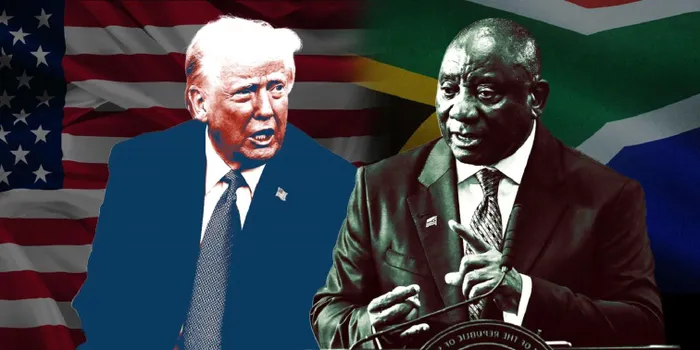
President Donald Trump’s foreign policy pronouncements present a chaotic search for meaning.
Image: Siyabonga Hadebe / Supplied
UNITED States President Donald Trump’s foreign policy pronouncements present a chaotic search for meaning.
His threats against South Africa, Nigeria and Afghanistan, coupled with the termination of Agoa and “crazy” tariffs, seem inconsistent. However, reading this as a complex strategy grants it undue sophistication.
The driving force is not a nuanced doctrine but a raw thirst for critical minerals. These resources underpin modern economic development, technology, and national security. The strategy is not complex but a bare-knuckled attempt to bargain cheaply.
The veneer of justification is thin and often contradictory. Trump’s boycott of the G20 in South Africa cited the “disgrace” of treatment toward white farmers. This moral outrage is conspicuously selective, ignoring complex internal debates.
The subtext, however, is what truly matters. South Africa holds 90% of the world’s platinum group metals, which are essential to the green transition. It is also the largest producer of manganese and a dominant force in chromium.
This same tactic is employed again and again with unmistakable obviousness.
The threat to go “guns-a-blazing” into Nigeria targets a country with vast lithium and cobalt reserves. Similarly, the demand for Bagram Airbase from the Taliban coincides with Afghanistan’s untapped mineral wealth.
The economic framework supporting this is the dismantling of cooperative trade. The lapse of Agoa and imposition of contested tariffs are not just policy shifts but are weapons designed to create leverage and systemic disruption.
This forces nations reliant on US market access to the bargaining table from a position of weakness. They become more susceptible to one-sided deals on mineral rights.
However, this contrasts sharply with the approach taken elsewhere.
With strategic allies in Asia, the playbook is one of partnership and capital deployment. The bilateral minerals agreements with Japan and Australia are notably more advanced and immediately actionable.
The language is that of mutual benefit for traditional Western allies and others.
But for Africa, the language is one of threats and economic pressure. The continent is treated not as a partner but as a resource-rich target for cheap acquisition. It is viewed as a tool in a power competition.
The ultimate goal is to break China’s stranglehold on critical mineral supply chains. Beijing currently controls 85% of global rare earth processing. Its massive trade relationship with Africa dwarfs that of the US.
The method, however, is not to out-compete China with better offers or equitable partnerships. It is to create economic distress and political uncertainty. The aim is to compel African governments to grant concessions on unfavourable terms.
There is nothing subtle to be read into Trump’s sustained attacks on South Africa. The moralistic pretexts are flimsy covers for a resource grab. The strategy is a simple, brutal calculus: apply maximum pressure to secure a minimum price.
Siyayibanga le economy!
* Siyabonga Hadebe is an independent commentator based in Geneva on socio-economic, political and global matters.
** The views expressed here do not reflect those of the Sunday Independent, Independent Media, or IOL.