

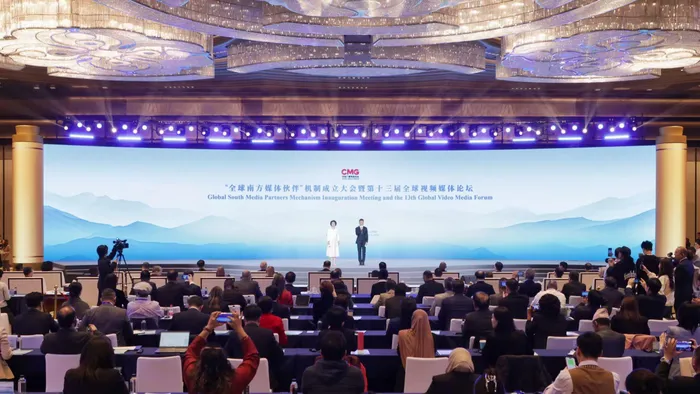
A large contingency of media bosses from across the Global South converged on the Chinese city of Xi’an, a state-built cosmopolitan and national central haven of some 13 million permanent residents, to map out a path to a new world order.
Image: Supplied
A LARGE contingency of media bosses from across the Global South converged on the Chinese city of Xi’an, a state-built cosmopolitan and national central haven of some 13 million permanent residents, to map out a path to a new world order.
The event, held this week in the middle of the Chinese Autumn, was dubbed: “Global South Media Partners Mechanism Inauguration Meeting” and also incorporated the marking of the “13th Global Video Media Forum”.
It was held under the umbrella of the world’s biggest media house, the China Media Group (CMG), with offices in more than 60 countries worldwide and more than 1 billion in audience figures. Also at the centre of putting the mega event together was the Communist Party of China (CPC), which is at the core of the country’s governance system and political direction.
The meeting saw representatives from Latin America, Africa, the Middle East and Asia. It is an intimate affair of little stock-taking and more the thrashing out of the way forward.
“For far too long, we’ve said the Global North does not respect us, but respect must start with ourselves,” said Fan Yun, Deputy Editor-in-Chief of the CMG and Editor-in-Chief of CGTN.
Like all speakers, Yun appealed for urgency in the Global South media cooperation, saying the time to act had come.
Saudi Arabia’s Head of Media Operations at Al Arabiya Media Network, Dina Nimer, said: “Global South media cooperation is no longer optional. It is essential.”
It was heart-warming to notice the overwhelming attendance of the inaugural conference on the intentional declaration of the China-led Global South media cooperation. It will be marked by exchange of technologies and training through exchange programmes, content and experience sharing, as well as the deliberate amplification of the Global South voices in international affairs.
The success of the conference was marked by the signing of the historic “2025 Global South Media Dialogue Consensus”. It was interesting that it was signed by heads of media houses across the Global South, with an added desire to promote South-South relations.
Five key points from the declaration read as follows:
I found the document both erudite and courageous at the same time. Additionally, the dynamic document offers a framework for the immediate way forward in terms of solidifying the Global South voice as a united force to reckon with.
As speaker after speaker alluded to, for far too long the Majority World has played second fiddle to what can only be accurately described as a “Minority World” that is the domineering Global North, the beneficiaries of a post-WWII international world order that was birthed when half the UN member-states only existed as colonies of the European conquerors.
South Africa and the AU, the Arab League, Latin America, Asia and the entire Majority World have been crying out for the reforms of the UN system. Everybody seems to agree that it is obsolete, yet the most powerful inside the UN system continue to retain the archaic systems and structures of the world body.
It is an anomaly that, through China, the Global South has now rallied to circumvent at least through the media collaboration. After all, journalism is not merely about news coverage. Fundamentally, it is about media representation, agenda-setting and the influence of public opinion.
The inaugural conference in China shows the entire world that it does not help to continue to complain about the pillars of an outdated world order. Instead, given the resources, and in particular the brains and courage, former colonial territories that have truly come out of their shell need to focus on themselves — instead of others — and fashion a new way of life where instruments such as the impactful media are channelled in the right direction and driven in ways that benefit the new, emerging world.
As Anthony Greene, President of the Caribbean Broadcasting Union, told the conference: “Global South media cooperation is more necessary than ever”.
* Abbey Makoe is Founder and Editor-in-Chief: Global South Media Network (gsmn.co.za). Views expressed are wholly personal.
** The views expressed here do not reflect those of the Sunday Independent, Independent Media, or IOL.