

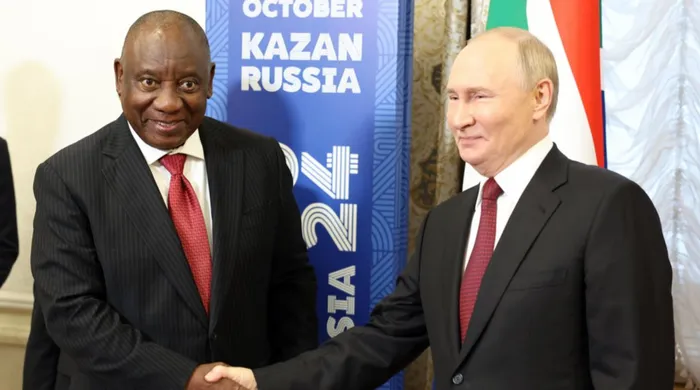
President Cyril Ramaphosa with President Vladimir Putin of Russia. FOR the second time in quick succession, Russian President Vladimir Putin will be unable to attend a very important gathering on South African soil.
Image: The Presidency / X
FOR the second time in quick succession, Russian President Vladimir Putin will be unable to attend a very important gathering on South African soil. First, it was the BRICS Heads of State Summit in August 2023, which was held in Sandton, Johannesburg.
This time, President Putin is again unable to attend yet another global event of great significance in South Africa — the G20 Heads of State and Government Summit from November 22-23.
Dubbed the G20 Johannesburg Summit, it will be the 20th meeting of the Group of 20 (G20), the first to be held not only in South Africa, but on the African continent as a whole.
Putin will not be joining a plethora of heads of state at the G20, not because he has elected to — but because the South African government has chosen such. It is the same unfortunate choice the South African government made during the 2023 XV BRICS Summit. I find such choices very problematic in the grand scheme of geopolitics. Let me tell you why.
Relations between Russia and South Africa’s political elites in the ANC date back decades. When the rest of the Western world declared the ANC as a terrorist group for waging armed Struggle against apartheid, the Soviet Union were the bulwark of the ANC’s material support. The ANC received military training, weapons, particularly the hugely popular AK-47s, educational scholarships and refugee status, among others.
The Soviets further took great care of the health of the leaders of the ANC and the SA Communist Party (SACP). Two examples come easily to mind: First, it was the death from a heart attack of the ANC stalwart JB Marks on August 1, 1972, in Moscow. He was 69. Secondly, it was the death of the SACP Chief Moses Kotane, also in Moscow, on May 19, 1978. He passed away in Moscow after suffering a stroke. He was 72.
Of great importance is the hero’s burial, which the Soviets awarded to the two extraordinary South African freedom fighters. Their burial sites were declared special heritage zones. The ANC negotiated with the Russian government to exhume the remains of both Marks and Kotane in 2015 and reburied them in separate state reburials in their villages of origin in the North West province — Kotane in Phela and Marks in Ventersdorp.
The villages of both leaders have since been renamed after them — Ventersdorp falling under the greater JB Marks Local Municipality and Phela falling under the Moses Kotane District.
I am at pains to paint this historical picture for context of why, in my view, bilateral relations between South Africa and Russia ought to remain at their most cordial at all material times. There is a relation forged when it was not fashionable, during the most difficult times, when a tiny minority in South Africa oppressed a large majority with great assistance from countries such as the UK, Germany and the US, among others.
The ANC leadership of today will do well to emulate Nelson Mandela’s presidential posture when he dared the West in the early days of the ANC rule, saying, “no one will choose who our friends are, or should be”.
Mandela was reacting to some expressed reservations over the ANC’s open embrace of Yasser Arafat of the Palestinian Liberation Organisation (PLO), Fidel Castro of Cuba, whom Mandela addressed as “my brother and comrade”.
Now, the domineering neoliberal cohort within the ANC has obviously succeeded in steering the once glorious movement away from its original socialist traits. In the same vein, the ANC has sadly moved away from its original allies, such as Russia, in favour of the West, long-time supporters of apartheid and labellers of the ANC as a terrorist organisation.
Granted, South Africa is a signatory to the Rome Statute and therefore bound by the dictates of the International Criminal Court (ICC). The ICC, at the behest of the West, issued a warrant for the arrest of Putin right at the beginning of the Ukraine war over allegations of kidnapping Ukrainian children.
This is a claim the Kremlin has vehemently denied. Moscow says it removed minors from the combat zones in the Donetsk region in Eastern Ukraine. In fact, Moscow has expressed willingness to hand the children back into the custody of their parents or guardians. So far, dozens of the children have been returned to their legitimate families at various intervals.
Moscow has also undertaken to pay the travelling costs of the families to fetch their loved ones. Only a fortnight ago, Russia released another batch of such children back to their families in Ukraine. This was with the assistance or intervention of the US First Lady, Melania Trump.
Therefore, it is evident that there are many moving parts to the ICC’s allegations against President Putin. And then, of course, the ICC itself does not have a credible reputation. It is renowned to go after primarily African leaders, and a few anti-West here and there.
The whole saga of the inability of President Putin to attend important international events on South African soil because Pretoria will arrest him poses pertinent questions to our country’s foreign policy.
The Department of International Relations and Cooperation (Dirco) need to educate the public much more about what influences and impacts SA’s national interest. In fact, whatever Pretoria’s set of national interests is — upon which foreign policy is drafted — when did relations with Russia fall so low in the pegging order, and why?
Through all these drastic changes, that include dumping old friends for new neoliberal ones whose interests are represented no longer by the DA alone in the public discourse and governance, but also by the dominant faction of the ANC itself, which side of the Global North or Global South is Pretoria supporting?
There are several dangers in South Africa’s wishy-washy foreign policy. It is a foreign policy that pretends to be everything to everyone, meekly described as non-aligned. Yet on the strength of evidence, South Africa’s foreign policy is bordering on the cantankerous.
Washington has recently threatened stern action against BRICS should the bloc surge ahead with de-dollarisation. Whereas BRICS member-states such as China, Russia, India, and Brazil appear to have indicated a “bring it on” posture, Pretoria is the odd one that appears to want to assure the US that “we aren’t the bad boys”.
Among the dangers that I see lurking, and I have a foreboding fear for this, is that within BRICS itself, South Africa is increasingly viewed unfavourably. Our penchant to have both our feet in all sides does not help at all. There is honour in working out a stance in geopolitics and standing by that stance. At least allies and foes will know where to stand. A foreign policy such as Dirco’s that oftentimes undermines its own interests is worrisome.
Mandela and the ANC bestowed on South Africa moral supremacy, and it is this inheritance that I am afraid we seem to have lost. No one should have been allowed to choose who our friends are, or should be. That is Mandela’s statement of fact, uttered without fear or favour.
Finally, for South Africa, beware the Ides of March. At the rate that Pretoria is conducting itself, those who originally invited us into BRICS could carry out their growing desire to kick us out of the bloc. This will be an outcome so desired by neoliberalism in our imbalanced political framework and ideologically governed governance architecture.
* Abbey Makoe is Founder and editor-in-chief of the Global South Media Network. The views expressed are his own
** The views expressed here do not reflect those of the Sunday Independent, IOL, or Independent Media.