

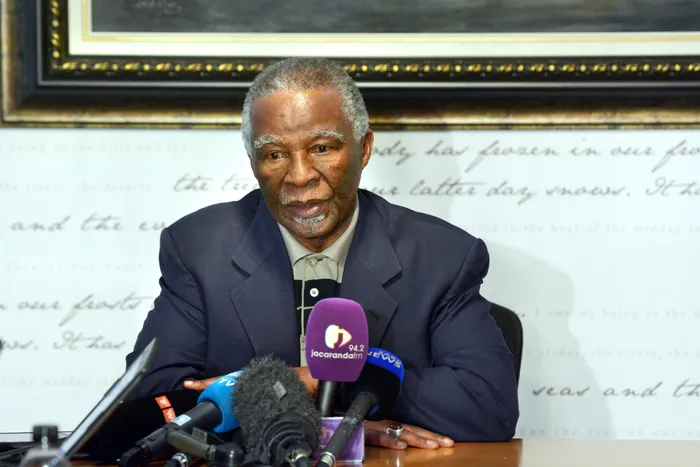
When Thabo Mbeki took the helm from Nelson Mandela, South Africa and the world regarded him as the urbane and intellectual African statesman.
Image: Karen Sandison / Supplied
SINCE the fall of apartheid, there has been an increase in immigrants seeking entry into South Africa from all over the African continent. With the influx of immigrants seeking entry into South Africa, the government has had to enact legislation and formulate policies that regulate, enforce and control the admission of foreigners into the country as well as their departure from the country.
It was in 1999, when Thabo Mbeki took the helm from Nelson Mandela, South Africa and the world regarded him as the urbane and intellectual African statesman. Indeed, Mbeki has done a lot of good since ascending to South Africa’s presidency in 1999.
He was a significant force in Africa’s drive to democratise, for example.At home, democracy and its institutions have remained generally strong. For this, Mbeki merits credit. Under his watch, the economy grew, albeit at a price to the poor and on the back of the unavailing trickle-down theory of economics.
The Mbeki government did not perform well on issues such as crime, housing, education, land reform and corruption, invasion of illegal immigrants. It was under the leadership of Mbeki that Section 27 of the South African Constitution made guarantees for illegal foreigners the right to access healthcare, including social security.
Thus, this generation should call for constitutional amendments that should clarify and safeguard important rights against “misapplication and abuse, particularly where individuals who have entered the country illegally seek to exploit them.”
As active citizens, we have a right to defend the interests of this country, which is what unites us, even before the dawn of democracy, is the determination to build a better South Africa for South Africans, first and foremost.
The proclamation of the Freedom Charter that says South Africa belongs to all who live in it was never our pledge as this current generation; it was the generation of former President Mbeki’s generation who made this proclamation, thus we don’t associate ourselves with this because circumstances on the ground refuse us to echo these words.
This is only through the efforts and commitment of ordinary citizens who have dedicated their energies to taking South Africa forward by working together to build a better tomorrow, and we were not building a better life for illegal immigrants but for our future generations. We have been at the forefront of leading our country since 1994 and will continue to do so as we embark on a new chapter, a chapter without illegal foreigners.
We have a crisis of undocumented or illegal immigration in this country, and it’s having a knock-on effect on service delivery. South Africa doesn’t belong to illegal immigrants — we have between 5 and 10 million illegal immigrants in this country, with our limited resources that are meant to cater for its citizens.
Clinics in some parts of the country are recording over 70% of patient files belonging to foreign nationals, and schools are struggling to meet placement demands owing to court-ordered enrolment of illegal immigrants. South Africa’s already limited resources are under severe strain and have resulted in the diversion of essential services away from South African citizens, which undermines their access to critical healthcare and education.
I am extremely disappointed by Mbeki’s utterances directed to Operation Dudula for standing up and defending the rights and interests of South Africans when the government is failing to act against illegal immigrants. Former President must be careful not to sit in his ivory tower comforts and rebuke or dictate how the poor class should behave or how their plight finds expression because he is detached from the daily living realities.
Illegal migration in South Africa has a bad impact on national security, and your own government former president doesn’t have an appetite to look at policy and institutional options to address this problem.
The South African government is fragmented in its efforts, without the required legislation, systems, capacity, and level of security required to enforce compliance and to secure its borders. This, for years, has compromised the border controls and exposed South Africa to illegal migration while you were still the president of the republic, which resulted in conflicts between local citizens and migrants-and transnational crimes.
Instead of throwing distasteful remarks at Operation Dudula, you should be sending a strong message to the ANC NEC, which you once led and sit in its meetings, that they must apply stronger governance measures that may include clearly defined, comprehensive, integrated, coordinated migration policies and practices, based on security, economic, social and development concerns.
While you sit comfortably in your Houghton Estate retirement home, with the R3.5 million on security measures, ordinary citizens and children are human trafficked, youth are on drugs, and illegal mining continues unabated.
More than this, the ANC government does not know how many people are here illegally and how many people are placing an unaccounted-for burden on service delivery, and your only worry is Operation Dudula, which is defending the rights and interests of ordinary citizens.
President, the failures of Home Affairs started during your tenure, and you were never bothered, as you continue not to be bothered about the lives, the security of ordinary South Africans.
To prevent, detect, and correct undocumented migration means that many thousands of undocumented migrants have been living in South Africa for long periods of time. Mass deportation is not only fiscally prohibitive, but it may also very well be unjust to the immigrants in question and harmful to their communities.
The failing immigration system also means that law enforcement agencies cannot effectively combat crime. Law-abiding citizens and residents cannot feel safe in South Africa because they cannot be confident that law enforcement agencies have a handle on the scale of cross-border crime.
As I put down my pen, I ask you unconditionally to respect the life of a Black child, let a Black child be at peace in his ancestral land of birth, rather than to live in submission and scorn of the sacred of an unashamed and unremorseful white supremacist principle.
South Africa, do not weep for our forbearers who suffered so much, as my generation will know how to defend your liberation achievements and your freedom.
May God bless Africa and her children!
* Nhlanhla Mosele is a founding member of Qonce People’s Parliament.
** The views expressed here do not reflect those of the Sunday Independent, IOL, or Independent Media.