

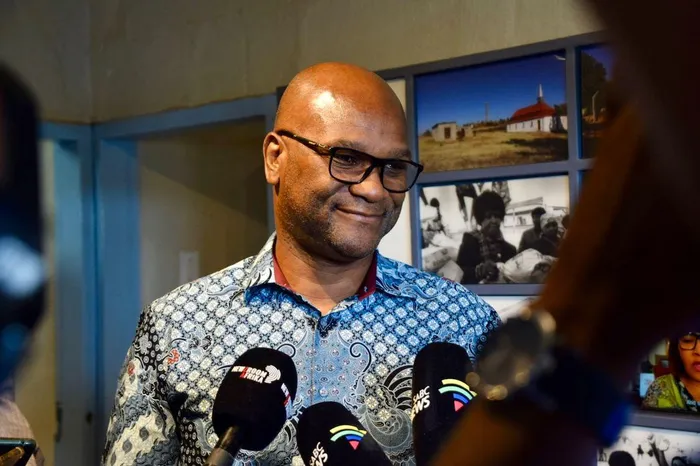
THE late ambassador Nathi Mthethwa, who died after falling from the 22nd floor of the Hyatt Regency hotel in Paris last week. He will be laid to rest on Sunday in a special official funeral category 2.
Image: James Mathibeng / Supplied
THE passing of Nathi Mthethwa sent shockwaves through our movement, leaving a void filled with unanswered questions. How could a revolutionary die with his task unfinished?
It is a question that haunts us, a stark reminder of the long and arduous journey that still lies ahead. Yet, amid the grief and confusion, one thing remains certain: Comrade Mthethwa was incapable of betraying the revolution. For him, the revolution was not a mere political slogan; it was a sacred cause, a lifelong commitment to transforming the lives of our people and breaking the shackles of poverty, inequality, and unemployment.
I first encountered Mthethwa during my time as the president of the Congress of South African Students (Cosas). He was a towering figure, a central force in the ANC’s ideological architecture. As a champion of the party’s strategy and tactics, he was instrumental in shaping its political education and organically strengthening its roots as a movement of the people.
He was a product of a generation that straddled two worlds: the brutal reality of apartheid and the dawning of a new, democratic South Africa. He had experienced the injustices of the past, the systemic exclusion that sought to crush the human spirit. But he had also witnessed the birth of a new nation, a nation he would help to shape from the reins of power.
Mthethwa was a young lion, his roar a revolutionary act that reverberated across the social fabric of South Africa. His ascent to the leadership of the ANC was a testament to his unwavering discipline and profound understanding of the task at hand. He began his journey in the ANC Youth League, crisscrossing the country with the former secretary general, Kgalema Motlanthe, his dedication and tireless work earning him the trust of the people.
This trust propelled him to the position of chief whip, where he was tasked with the immense responsibility of steering the political and administrative work of the ANC in parliament. His journey did not end there. He would go on to serve as the minister of police and, later, as the minister of sport, arts and culture.
To ensure that his death is not in vain, we have a solemn duty to preserve his legacy, a legacy inextricably linked to the ANC. He was a product of the party, his entire being shaped by its ideals and aspirations. He was socialised to think and act within the framework of the national democratic revolution, his every action a step towards the realisation of the Freedom Charter.
His generation was at the forefront of the struggle for the economic transformation of South Africa, a struggle that continues to this day.
The end of national oppression in 1994 was a monumental victory, but it was not the end of the struggle. Mthethwa’s generation has passed the baton to us, entrusting us with the historic mission of ending class oppression. We must challenge the status quo, dismantle the structures of inequality that continue to plague our society.
His story cannot end with his death; it must culminate in the realisation of our generational mission: economic freedom or the death of us. To fail in this mission would be a grave injustice to the generations that will follow.
As the minister of arts and culture, Mthethwa championed the transformative power of culture, history, and heritage in national healing. In a country where identity was weaponised under apartheid, this was a task of paramount importance.
It was not a mere accident of political appointment; it was the fulfilment of his generational mission, a mission he had carried with him since his days in the ANC Youth League. He understood that a nation’s soul resides in its culture, its history, its heritage. He knew that to heal the wounds of the past, we must first reclaim our identity, our stories, our voices.
Mthethwa was a devoted student of strategy and tactics, the ANC’s long-term vision for a transformed South Africa. He was not swayed by the fleeting allure of populist politics, the empty promises of easy solutions to complex challenges.
When he spoke in parliament, his words carried the weight of his convictions. He had a rare ability to break down the complex challenges facing our people, to offer tailored solutions that were both practical and visionary. His patience and sophistication were a testament to his deep understanding of the struggles of the masses.
The ANC Youth League will forever honour and celebrate the life of Comrade Nathi. He was a product of the Youth League; his political consciousness forged in the crucible of its struggles. He played a pivotal role in the transition of the Youth League, serving as a prominent organiser and holding multiple leadership positions, including regional secretary and NEC member between 1990 and 2001.
He later joined the ANC’s national organising team before entering parliament in 2002, where he served until 2023. His unwavering dedication to the building of the ANC and the ANC Youth League was a testament to his understanding of the twin tasks of the Youth League: to mobilise young people towards the ANC and to prepare them to be the future leaders of the party.
In conclusion, legacy is not a monument of stone, but a living, breathing testament to a life dedicated to the revolutionary cause. It is a legacy of courage, of conviction, of unwavering commitment to the people of South Africa. It is a legacy that we must carry forward, a legacy that must inspire us to continue the struggle for a truly transformed, truly free South Africa.
The lion may have fallen, but his roar will echo through the ages, a constant reminder of the unfinished task that lies before us.
* Collen Thlologelo Malatji is the president of the ANC Youth League.
** The views expressed here do not reflect those of the Sunday Independent, IOL, or Independent Media.