

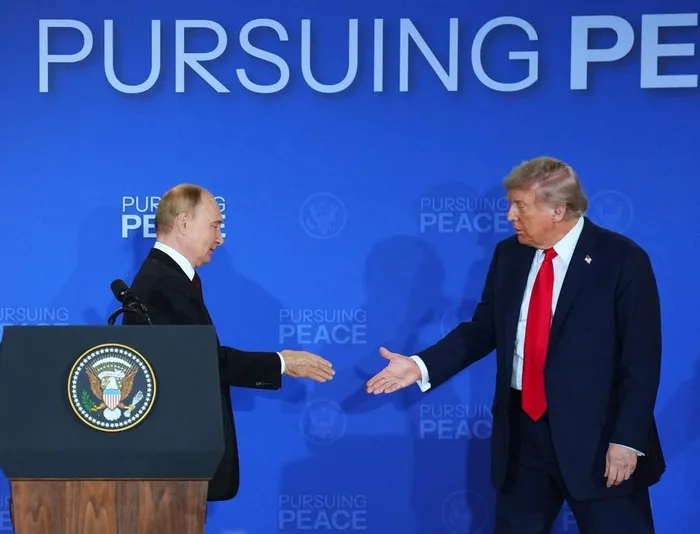
At the behest of the Kremlin, Trump held a two-and-a-half-hour telephone meeting with his Russian counterpart, President Vladimir Putin.
Image: Xinhua
RIGHT in the immediate aftermath of the fragile Gaza peace deal, US President Donald Trump appears set to keep his momentum, hinting at pulling off a spectacularly similar deal in Ukraine.
At the behest of the Kremlin, Trump held a two-and-a-half-hour telephone meeting with his Russian counterpart, President Vladimir Putin.
They discussed several key issues, among them the potential supply of the US Tomahawk missiles to Ukraine, which Moscow pointed out, would amount to an exercise in futility as it would not change the frontlines but would instead damage the rapidly improving US-Russia relations, according to Yuri Ushakov, the Kremlin Aide.
Trump hinted at the possible rescinding of the decision on the Tomahawk missiles, saying that the US needed the missiles too, as Washington could not afford to empty its arsenal over the need to supply Kyiv.
Putin emphasised Russia’s desire for a political and diplomatic solution to the devastating conflict in Ukraine, sparked in February 2022 when Moscow felt that the West — through NATO’s expansion eastward — was posing an existential threat to Russia’s national security.
Russia describes its move inside Ukraine as a Special Military Operation. The West, led by the US, NATO and the EU, collectively decried what they termed Russia’s “invasion” and the undermining of Ukraine’s sovereignty.
The fallout between the West and Russia has been extraordinary. It resulted in the unprecedented imposition of economic sanctions against Russia and moves to isolate the nuclear superpower internationally.
However, in an international architecture characterised by growing unilateralism and improving South-South relations, sanctions against Russia have failed to yield the intended results.
To compound matters, the Russian economy has continued to perform optimally, growing markedly since February 2022.
Although some powerful NATO and EU member-states such as Germany, France, and the UK have sought military confrontation with Russia, the Trump White House has elected a more diplomatic approach to ending the conflict.
This week, while engaged in intense telephone discussions with Putin, Trump proposed that his summit with Putin be held at a neutral venue. He went on to choose Budapest, the Hungarian capital. Putin agreed at once.
Hungarian Prime Minister Viktor Orban is almost a rare geopolitical breed of the latter-day. He is an ally of both President Trump and President Putin at the same time. In the sessions of the EU, Orban has also spoken publicly against the sanctions and isolation of Russia, stressing that they all need each other.
In fact, President Trump and Orban held a phone call this week, too. It prompted Orban to post on his social media X account: “Preparations for the USA-Russia peace summit are underway.”
The US Secretary of State Marco Rubio and his Russian counterpart, veteran diplomat Sergey Lavrov, are currently working out the modalities of the meeting and an announcement on the finalised way forward can be expected pretty soon.
Of course, Trump is not perfect. I am certain that he would be the first to admit. However, there can be no denying that despite his oftentimes unconventional approach to international relations, President Trump can never be faulted for lack of trying. Cantankerous as his approach might sometimes seem to be, America’s 45th and 47th Presidents get 10 out of 10 for both effort and enthusiasm.
This is what the world needs at this juncture – a leader who can get their hands dirty. There has simply been too much loss of life and limb, destruction of infrastructure and drastically increased threat of the outbreak of WWIII. The world has too often teetered on the brink of a catastrophe. I cannot continue to be the reality of our times. It is in this context that President Trump, the most fallible of them all, is equally the very best of the lot.
Europe is not necessarily unanimous in Russophobia. There are several who are like Hungary’s Orban. It is only that Germany, France and the UK are a Triumvirate driven by self-serving interests, such as the desire to continue enjoying the status as Europe’s uppermost political elite.
They are also part of the traditional nucleus of the EU. To this day, despite the rapid expansion of the EU in the aftermath of the collapse of the Soviet Union at the turn of the 1990s, the Triumvirate is the core of Western Europe that founded the EU, while the bulk of the late-comers emerged out of the ashes of the Soviet Empire. Although on paper all EU member-states are equal, in practice the opposite is true.
The EU’s limitations in any desire they may harbour to confront Russia militarily stems from their foreboding fear of taking on a nuclear power without the back-up of the US. Hence, they have all been crying for President Trump to guarantee a backstop so they may send their soldiers to guard Ukraine in a post-conflict architecture. Again, Moscow is vehemently opposed to the idea and has communicated the same to the White House.
After his telephone discussions with Putin, Trump promised to take into account Russia’s concerns in working out a truce.
Again, for those who may not know, before Trump returned to the White House, his predecessor, Joe Biden, was war-talk and different kinds of threats and less talk about a negotiated settlement.
Again, imperfect as he may be, Trump seems like the best the international community can offer in pursuit of peaceful resolutions to conflict.
* Abbey Makoe is Founder and editor-in-chief of the Global South Media Network. The views expressed are his own
** The views expressed here do not reflect those of the Sunday Independent, IOL, or Independent Media.