

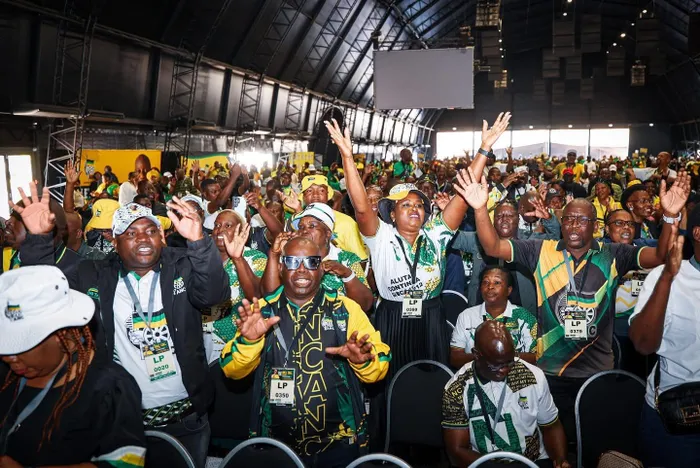
Thousands of ANC councillors gather at FNB Stadium in Johannesburg for a party meeting ahead of the 2026 local government elections.
Image: Facebook/ANC
Last month, the African National Congress (ANC) gathered more than 4800 of its councillors and mayors at the FNB Stadium in Nasrec, Johannesburg.
The so-called “roll call” was heralded as a moment for self-reflection and re-commitment to the party’s promise of effective governance, particularly in the lead-up to the 2026 municipal elections. Yet, the spectacle raised important questions about the ANC’s capacity for real reform and whether this event was a genuine call for accountability or simply political theatre.
A Critical Moment for Local Governance
The ANC, the party that has ruled South Africa since the end of apartheid, is undeniably facing increasing challenges — especially at the local government level. Issues like corruption, mismanagement, service delivery failures, and rampant unemployment have severely eroded the party’s credibility. Municipalities under ANC rule have become synonymous with poor infrastructure, unreliable public services, and a general malaise that has left many South Africans disillusioned with their local leaders. For a party that once commanded unquestioned loyalty, the ANC now finds itself under intense pressure to prove it can still govern effectively.
The roll-call meeting, billed as an attempt to reorient the party, was ostensibly designed to address these issues head-on. President Cyril Ramaphosa and Gwede Mantashe, among other senior ANC leaders, seized the opportunity to criticise the “unruly” behaviour of councillors and mayors who attended, highlighting their failure to act decisively in the face of growing problems. Ramaphosa, in particular, took the moment to remind councillors that their priority should be to "put people first," referring to the devastating service delivery crises and municipal dysfunction. However, while the intention behind such calls may have been noble, the question remains: Is the ANC truly ready to tackle these issues, or is this just another exercise in self-flagellation designed to soothe the public’s anger without offering meaningful solutions?
The ANC’s “Discipline Problem”
One of the most striking aspects of the roll-call event was the palpable discontent that emerged within the ranks. Disruptions during the event, such as loud singing, noise, and disorganised behaviour, were pointed out by Mantashe, who scolded the councillors for their lack of discipline. This chaotic scene laid bare a central problem for the ANC: the culture of inefficiency and a lack of respect for institutional processes. If ANC councillors can’t behave responsibly during an event designed to promote accountability, how can they be expected to govern effectively? The incidents at the roll-call are indicative of a deeper leadership crisis within the party.
Many ANC councillors appear more interested in political showmanship than in undertaking the hard work necessary to transform municipalities. The factionalism within the ANC has also fostered a culture of internal divisions, where party loyalty often takes precedence over good governance. This situation is particularly damaging when councillors, who are entrusted with the power to make decisions on behalf of local communities, act with little regard for the consequences of their actions—or lack thereof. While it’s easy to point fingers at individuals, it’s important to consider the wider systemic issues that have allowed these dysfunctions to persist. For years, the ANC has been unable to establish an effective accountability framework for its councillors. The roll-call, in this regard, feels like a superficial attempt to regain control, rather than an earnest step towards addressing the root causes of the party’s governance failures.
Ramaphosa’s Call for Action
Ramaphosa’s speech at the event highlighted the need for a “Service Delivery and Infrastructure Action Plan” — a bold initiative that seeks to hold ANC councillors accountable for the services they provide to their communities. This move, while commendable, is yet to be tested in practice. Over the years, many such "action plans" have been rolled out with little to show for them. The ANC’s track record in implementing reform is questionable at best. There’s a tendency within the party to make grand promises that sound good in speeches but falter when it comes time for execution. The question is not whether Ramaphosa can identify the problems, but whether his party can mobilise the political will to carry out the necessary reforms. Accountability requires more than just speeches; it requires consistent action and a willingness to make tough decisions — such as replacing incompetent councillors or addressing the deep-rooted issues of party patronage and corruption that plague local governance.
Political Theatre or Genuine Reform?
Despite the rhetoric at the Nasrec roll-call, it’s hard to shake the feeling that this event was more about political theatre than substantive change. The very notion of a “roll-call ”— a public gathering of ANC councillors to reaffirm their commitment to the party’s values — feels like a PR exercise designed to appease critics and rally party members ahead of the 2026 local elections. The ANC needs to move beyond these symbolic moments and demonstrate its commitment to actual governance reform. To restore public confidence, the ANC must demonstrate leadership that transcends party loyalty. This means rooting out corruption, ensuring better service delivery, and promoting transparent decision-making. The party cannot afford another electoral loss in major urban areas like Johannesburg or Tshwane, where voters have increasingly turned to opposition parties like the Democratic Alliance (DA).
The ANC’s continued reliance on political theatre rather than real solutions will only further erode its already fragile base. The ANC’s roll-call meeting at FNB Stadium was a significant moment in the party’s quest to reassert its relevance and credibility. However, it remains to be seen whether this gathering will lead to tangible change or merely serve as a temporary distraction. For the ANC to win back the trust of South Africans, it will need to prove that it can govern effectively, hold its councillors accountable, and finally deliver the basic services its citizens deserve. Only then will the party’s rhetoric at events like the roll-call turn into meaningful governance, and not just another political show.
*Mayalo is an independent writer and the views expressed here are not necessarily those of IOL or Independent Media