

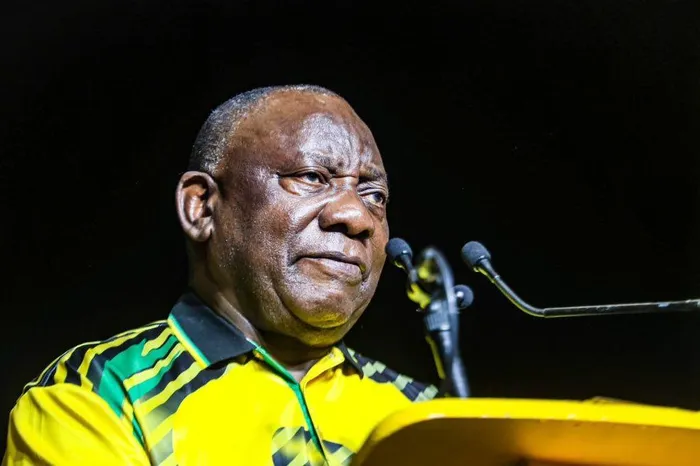
ANC President Cyril Ramaphosa’s recent utterances on DA-run municipalities have done nothing to improve perceptions.
Image: X/@MyANC
SOUTH Africa’s 2024 general election ended the ANC’s uninterrupted parliamentary majority since 1994, which led to the ANC negotiating a Government of National Unity (GNU) with multiple parties, including the DA.
This outcome has since intensified debate about the ANC’s internal cohesion and President Cyril Ramaphosa’s leadership, with some political commentators and senior ANC figures reportedly expressing concerns about the party’s direction.
The Sunday Independent reported about five years ago that some senior ANC figures alleged that Ramaphosa was working with external parties to collapse the governing party and replace it with a centre-right coalition led by him after the 2024 general elections. These claims are part of ongoing political discourse. Lo and behold, we now have a Government of National Unity (GNU).
Public commentary has included strong criticism of Ramaphosa’s strategy and messaging, and claims circulated in political discourse and on social media suggesting that he intended to “destroy” the ANC, but the jury is out on that.
A central part of the alleged plan was to elevate Ramaphosa above the ANC, so that if the ANC lost support, he could emerge as the undisputed leader of the centre-right coalition of opposition parties, excluding the EFF, after the 2024 general elections.
Also part of the alleged plan was to destroy independent media and the public protector’s office, take full control of the media, and drive a single and positive narrative about the country and its leaders, and make sure there is no mass-based movement that can challenge the new hegemony.
Interestingly, Ramaphosa was reportedly heard on a leaked tape, saying the ANC National Working Committee (NWC) had resolved to monitor what was described as negative reportage in the media. On the tape, Ramaphosa is reported to have said: “There has been negative reporting and all those things. We have agreed to take that up. We want fair treatment. We want more than fair treatment because we are the governing party. TV stations have no right to be negative towards us and are always either not reporting on our activities or just continuously branding us in a negative way. We have agreed as the NWC that there will be a team of comrades who are going to be watching the space, all the time, and we are going to make sure we take that up.”
The DA slammed Ramaphosa for this, saying the president’s directive to control media narratives and suppress negative coverage of the ANC was deeply concerning, adding that it was reminiscent of past attempts to capture vital institutions such as the SABC.
However, in a statement issued later in 2025 and in multiple speeches, Ramaphosa emphasised the ANC’s commitment to freedom of the press and democratic principles, noting that the party’s concern was about ensuring accurate and balanced reporting rather than media suppression.
He stated that the ANC welcomed critical journalism that holds leaders accountable while rejecting what he called “unjustified and politically motivated” negative framing that undermines public confidence in the government’s efforts to address South Africa’s challenges.
Analysts generally agree that the ANC’s reduced support reflects cumulative challenges. Where they differ is on how to weigh Ramaphosa’s responsibility versus broader, longer-term trends. This internal criticism is rooted in a specific set of allegations from within the ANC.
Claims have been made that the president and his business allies were going out of their way to privatise state-owned enterprises (SOEs) and destroy black-owned companies funded by the Public Investment Corporation (PIC) as part of a bigger plot to turn voters against the ANC.
These claims have been voiced in political rhetoric and are strongly denied by Ramaphosa and ANC leadership. Public statements by Ramaphosa highlight ongoing reforms aimed at strengthening SOEs and promoting black economic empowerment, underscoring a commitment to economic transformation within the framework of the National Democratic Revolution.
Meanwhile, political opponents, including the DA, sharply criticised the ANC’s record, but criticism from within the alliance and from analysts aligns with the narrative of a deliberate plot, though opinions on this are divided.
Xolani Dube, a political analyst at the Xubera Institute, was quoted as saying the root of unhappiness with Ramaphosa’s presidency within his own party was a perception that he ruled “at the behest of the mining energy complex” — a clique of powerful and wealthy families in the country.
Echoing the sentiment of the alleged plot, EFF leader Julius Malema also accused Ramaphosa of trying to sell the public’s assets to his friends. Malema said on Gauteng talk radio station Power FM, “Every little thing that we have as South Africans which we are proud of, this man is going to sell them to his white friends and that will be his legacy.”
The Presidency has categorically rejected these accusations. During his speech to the 2025 National Executive Committee (NEC) meetings and public addresses, Ramaphosa reaffirmed his administration’s commitment to protecting state assets and promoting inclusive economic policies that benefit all South Africans, particularly black communities and small businesses.
The Presidency and ANC, in turn, have argued that reforms were underway, citing steps in the energy sector and SOE governance changes. However, actions such as placing SAA under business rescue were seen by critics as evidence of the contentious plan.
A senior ANC leader, who supported Ramaphosa at Nasrec, reportedly accused the president’s business allies of pushing him to adopt economic policies that were opposed to those of the ANC. “We are selling everything now. By the time we wake up, we would have nothing to show as a country,” the source said, allegedly.
Ramaphosa’s recent utterances on DA-run municipalities have done nothing to improve perceptions, giving the DA a valuable opportunity to gloat gleefully at the ANC leadership’s expense.
He said: “Those municipalities that do best are not ANC-controlled municipalities… they are often DA-controlled municipalities.” This recognition validated what DA voters already believed — that the DA delivers better governance in certain areas.
The ANC, however, reacted negatively, with some party members seeing the statement as damaging to party unity and potentially emboldening the opposition. There was internal backlash accusing Ramaphosa of giving undue credit to political rivals at a sensitive time.
The statement also sparked broader debate about the ANC’s weakened position and the dynamics of the GNU. Public and media reactions included a mix of surprise, criticism, and strategic manoeuvring by both ANC and opposition political figures to leverage the moment in their favour.
Academic and independent analysts have noted that when ANC leaders acknowledge shortcomings, it could be an attempt to rebuild credibility while also underscoring the party’s internal challenges.
The intense factional conflict and the serious allegations that Ramaphosa is orchestrating the ANC’s collapse represent the most extreme manifestation of these internal challenges.
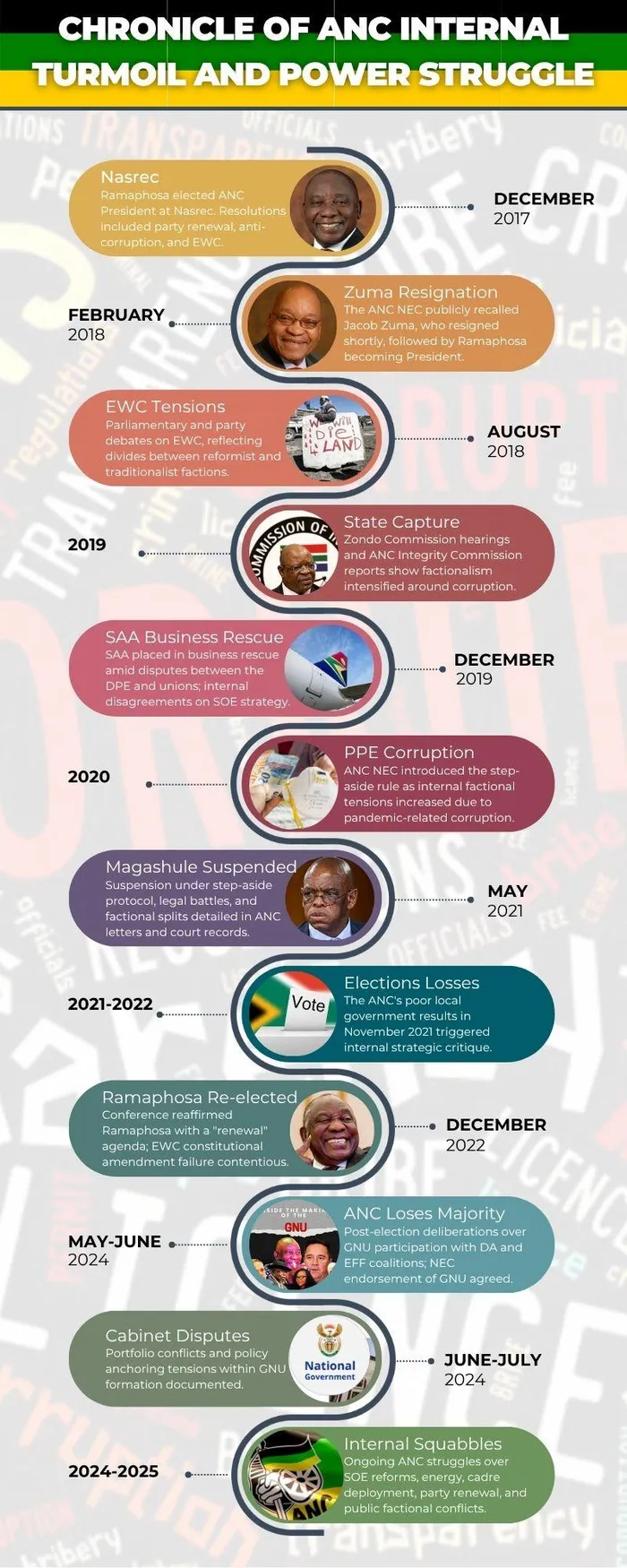
Chronicle of ANC's internal turmoil and power struggles
Image: Sizwe Dlamini / Sunday Independent
* Sizwe Dlamini is the editor of the Sunday Independent.