

The Reed Dance's significance has long been misunderstood, or dismissed, by Western scholars who deny the existence of African aesthetics, claiming that African societies lack the conceptual frameworks to appreciate art, beauty, or ritual meaning.
Image: Sibonelo Ngcobo
THE Reed Dance — known as uMkhosi woMhlanga among the Zulu and uMhlanga in eSwatini — is not merely a spectacle. It is a living performance of cultural memory, moral instruction, and collective identity.
Yet, its significance has long been misunderstood — or dismissed — by Western scholars who deny the existence of African aesthetics, claiming that African societies lack the conceptual frameworks to appreciate art, beauty, or ritual meaning.
This dismissal rests on ethnocentric assumptions. Scholars like Hugh Trevor-Roper once declared that Africa had “no history”, while others, such as Alan Merriam and Daniel Crowley, argued that Africans possess no distinct criteria for aesthetic judgment because they allegedly lack the vocabulary for beauty. Such claims ignore the very practices they purport to analyse. Where there is art, there is evaluation. Where there is dance, there is meaning.
Anthropologists have repeatedly imposed Western definitions of “art” and “aesthetics” onto African traditions, distorting their function and value. But African aesthetics are not abstract theories—they are embodied. They emerge through performance: through song, movement, attire, and ritual. To understand uMkhosi woMhlanga, one must observe it not as an ethnographic curiosity, but as a dynamic system of social transmission.
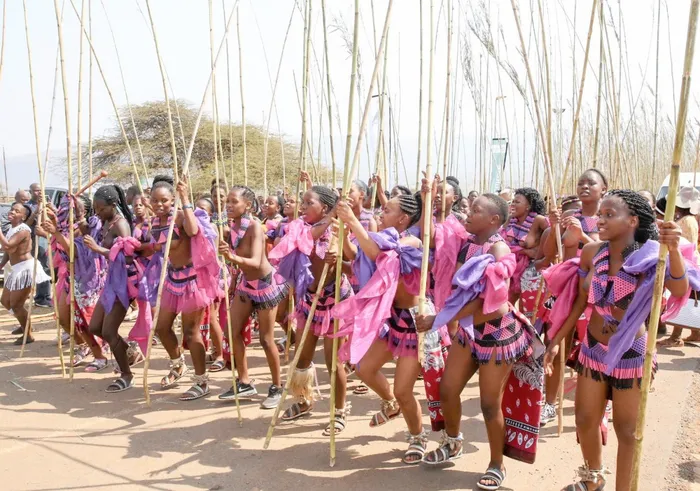
In this ceremony, thousands of young Zulu maidens gather annually at the royal residences in KwaNongoma and Ngwavuma, carrying reeds cut from riverbeds — a symbol of ancestral origin and natural vitality. Their procession, led by the chief princess, is accompanied by rhythmic singing and intricate beadwork. Each reed carries symbolic weight: according to tradition, if a maiden is no longer virginal, the reed breaks — an open, communal affirmation of purity.
The dance is neither entertainment nor tourism fodder. It is pedagogy. Through ritualised movement, values — chastity, discipline, respect, and communal solidarity — are transmitted across generations. As His Majesty Sobhuza II of Swaziland observed decades ago: “When they dance, they feel they are one.”
This is not a metaphor. Anthropological studies confirm that synchronised movement induces a state of “boundary loss”—a dissolution of individual ego into collective unity. In the Kalahari, hunters describe dancing as making their “hearts happy”. In Greece, ritual dancers speak of feeling “light, calm, and joyful”. These are not exoticisms. They are universal human experiences mediated through culture.
The Reed Dance also serves as a public health intervention. Revived in 1984 by King Goodwill Zwelithini during the height of the HIV/Aids crisis, it became a platform to promote sexual abstinence among youth — a culturally grounded alternative to imported medical narratives. Its success lies not in coercion, but in resonance: it aligns with existing moral frameworks rather than imposing foreign ones.
Importantly, the ceremony is not confined to Zululand. Similar traditions exist in eSwatini, where the event lasts eight days and reeds are presented to the Queen Mother, and in Zambia’s Kulamba Festival. Though differing in duration and detail, all share a common thread: the elevation of young women as bearers of cultural continuity.
Yet, despite its national stature, uMkhosi woMhlanga remains under threat — not from neglect, but from commodification. While tourism offers economic opportunity — guesthouses, curio stalls, local crafts — the commercialisation of sacred ritual risks reducing profound cultural expression to performative spectacle. Revenue generation must not eclipse reverence.
The solution is not to abandon tourism, but to manage it with integrity. The event should be protected as a non-commercial heritage practice, with tourism infrastructure developed around it — not within it. Communities must benefit economically without compromising the ceremony’s spiritual and moral authority.
Beyond economics, uMkhosi woMhlanga demands institutional recognition. It should be elevated to a national symbol — integrated into school curricula, taught in teacher training institutes, and replicated across provinces with cultural sensitivity. Similarly, the First Fruit Ceremony (*uMkhosi woSelo*) for young men must be restored as its complementary counterpart. Together, they form a balanced framework for gendered moral education in a time of escalating gender-based violence.
Africa does not need Western validation to affirm its aesthetics. The Reed Dance proves that African cultures possess sophisticated, embodied systems of meaning — systems that sustain identity, transmit ethics, and foster unity. To reduce them to folklore is to misunderstand the very nature of culture itself.
Culture is not preserved in museums. It lives — in the step of a maiden, the sway of a reed, the harmony of a thousand voices singing as one.
* Dr Vusi Shongwe works in the Department of Sport, Arts, and Culture in KwaZulu-Natal and writes in his personal capacity.
** The views expressed here do not reflect those of the Sunday Independent, IOL, or Independent Media.