

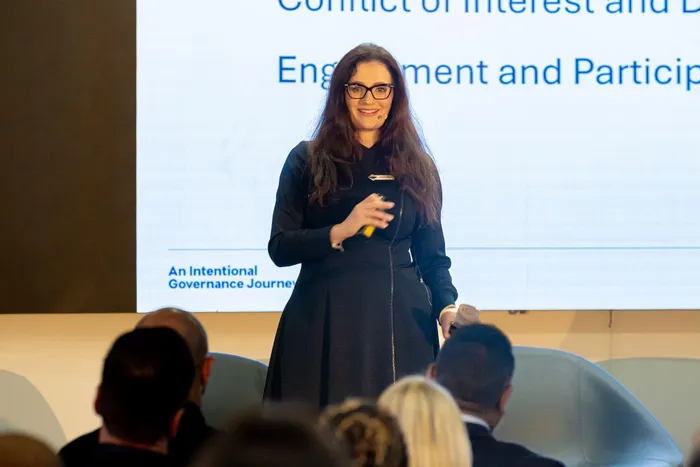
Ronelle Kleyn, FluidRock CEO, speaks at the third annual FluidRock Conference.
Image: Supplied
SOUTH Africa’s diversity is its superpower. It’s visible every time South Africans pull together, from supporting the Springboks to our ability to step away from the edge of the abyss, time and time again.
This unique strength was emphasised for me at FluidRock’s third annual conference. Speaker after speaker, from entrepreneur Vusi Thembekwayo to governance guru Professor Mervyn King SC, emphasised that embracing our diversity, and protecting it through governance’s rules and regulations, is essential to South Africa’s future success.
We need to collectively work towards South Africa’s future success. It is not an exaggeration to say that we are fast approaching the lip of the abyss.
As Thembekwayo pointed out, South Africa’s economy has grown at a combined annual growth rate of approximately 1.1% over the past 11 years – nowhere near the 6% year-on-year rate that economists suggest will provide adequate job growth.
Meanwhile, our population is growing, plus South Africa attracts migrants, mostly from elsewhere across Africa. Our trouble is that, as Statistics SA’s Quarterly Labour Force Survey for the second quarter of 2025 shows, employment is not rising.
Like all countries, we also face a world of increasing volatility, uncertainty, complexity and ambiguity (or Vuca), shaped by the many forces that are rapidly changing the world South Africa has to operate in — geopolitical upheaval, artificial intelligence (AI) and climate change, to name the most obvious.
Facing this world from within one of the world’s more diverse societies is an advantage, said Professor William Gumede, associate professor at the University of the Witwatersrand’s School of Governance. It allows us to “bring together the capacity and energy” of the different groups that make up our society. Done well, he argued, this is very powerful.
South Africa’s social diversity is perhaps most obviously harnessed in the government of national unity (GNU), which has just marked its tumultuous first year. While acknowledging the GNU’s fractious start, Gumede pointed out that his research shows that coalition governments are the most successful form of government in Africa since 1847, when Liberia became the first country to achieve independence from colonial rule.
The GNU offers South Africa “a potentially formidable structure to weather uncertainty”, he said.
Contestation such as that which has characterised the GNU is not necessarily a negative, Thembekwayo declared. Economic growth is premised on innovation, value creation and governance — aspects of a going concern that can be diametrically opposed. The tug-of-war that this clash precipitates is necessary for growth that is well-considered and risk-aware. “It’s about doing the right things right,” he said.
Finding ways to mobilise South Africa’s diversity is key to ensuring economic growth, said Gumede. For the GNU — and by implication South African society — to work optimally, good governance is “absolutely key”, he said.
Good governance is the bedrock for the trust that is required when people of diverse cultures and backgrounds need to work together, said Caitlin Gottschalk, the chief executive of Gottschalk Attorneys. “Corporate governance is not just a set of rules; it is a living system with a set of role players that has an effect on stakeholders.”
A lack of diversity is “a huge, huge red flag”, said Michael Judin, partner and joint owner of law firm Judin Combrink Inc. His statement was backed up by Anda Matwa, company secretary at Redefine Properties, who stated that diversity was part and parcel of board success.
Board success requires well-educated and informed board members from diverse backgrounds who take their oversight role very seriously, she said. The multitude of experiences that these people can bring to an organisation, along with a solid level of “professional scepticism”, can help the entity consider all options, from many angles, and so better weather the changes wrought by geopolitics, climate change and technology, including AI.
We agree — and this holds true for the public and the private sector.
It’s as Gottschalk said: every time the lights go out, it means that there has been a governance failure at Eskom. Open any news site and the litany of governance failures that sadly characterise South Africa at present is on display, along with its consequences — creditors not paid, jobs lost, families suffering.
To change the game for our beloved country, we need to think bigger, better and more effectively. We also need to comprehensively change our economics. As Thembekwayo pointed out, unless we create more value within the South African economy, our political and business leaders will continue to try to extract value from it. What else can they do?
Happily, there was a solution presented at the conference. It’s not really a radical idea, but South Africa has for too long struggled with how to do it: grow the mid-sized businesses that have potential. And, again, good governance is at the heart of the equation.
As André Nortjé, the chief executive of central securities depository Strate, said: the ability to demonstrate good governance within a business is vital for investment. Why would an investor put their money into a medium-sized private company if that business could not demonstrate the solidity of its business model?
It’s our biases, often unconscious, that keep us from trying new things, warned Sihle Ncube, governance consultant at FluidRock. While in-group bias is the one we’re most aware of, there are others, such as status quo bias — a prejudice Thembekwayo warned against — “because it worked yesterday, doesn’t mean it will work today”.
Another is one we are all familiar with: system justification, shorthand for the concept that individuals are motivated to defend and legitimise existing social, economic and political systems they are a part of, even when those systems disadvantage them. As we said above, governance rules and regulations are a safeguard against bias, promoting diversity, and diversity, in turn, protects good governance — it’s a virtuous cycle.
South Africa and Africa’s young population is, as Thembekwayo pointed out, a massive opportunity. While much of the developed world is facing the many challenges that arise when a population ages, Africa’s population is young — the United Nations estimates that the median age across the continent is 19 — and it is this young population that can drive economic growth, says Thembekwayo.
Also, sub-Saharan Africa has a growing middle class, burgeoning urbanisation and increased employment. “If you are building a business, this is what you are looking for,” he said. The question is how to take advantage of this opportunity. What is evident is that good governance lies at the heart of doing so.
* Ronelle Kleyn is the CEO of FluidRock Governance Group and an admitted attorney and corporate governance expert who brings over 26 years of corporate experience to her role.
** The views expressed here do not reflect those of the Sunday Independent, IOL, or Independent Media.