

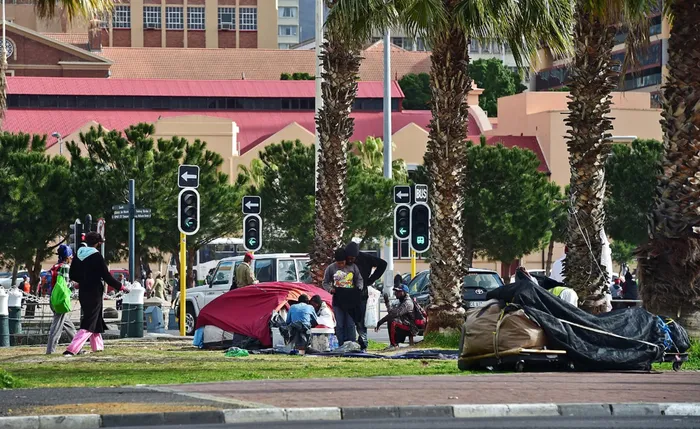
Scripture calls the rich to care for the poor, and the poor to labour with dignity. But beyond charity, the church must embrace its theological, educational, and pastoral responsibilities with prophetic urgency.
Image: Henk Kruger/African News Agency (ANA)
AS I reflect on the state of the church today, a haunting question arises: What happened to its once vibrant, prophetic voice?
Where is the moral outrage in the face of systemic poverty, unemployment, and human suffering? Why is the church so silent when eight million South Africans live without work? What has become of the radical, engaged faith that once challenged injustice?
In my earlier writings, I called for an “engaged spirituality” — a faith that refuses to retreat into sacred isolation but actively engages the social, economic, and political realities of our time. The church must not fear the messiness of public life. During apartheid, the church stood boldly, declaring, “Thus says the Lord.” It was unafraid to confront evil. Today, it must reclaim that courage. The nation still needs moral leadership, and the church remains uniquely positioned to provide it.
Alexander Radishchev, the pioneering Russian thinker, once wrote: “I gazed around myself, and my soul was wounded by human suffering. I then looked inside myself, and saw that man's troubles come from man himself.” His words resonate today. Suffering is not abstract — it is carried in the bodies of the unemployed, the hungry, the marginalised. Yet where are the voices that grieve with them? Where is the church?
Aleksandr Solzhenitsyn, upon receiving the Templeton Prize, warned that the root of modern catastrophe is humanity’s forgetting of God. He called the 20th century a vortex of atheism, where secularism drowned moral clarity and reduced life to the mere “pursuit of happiness”. Good and evil were ridiculed. The human heart, he insisted, is where evil first takes root — before it spreads into systems and societies.
General Douglas MacArthur echoed this truth after World War II: “The problem is theological,” he said. “It requires a spiritual recrudescence — a renewal of human character to match our scientific progress. It must be of the spirit if we are to save the flesh.”
This is the heart of the matter. True transformation begins not in policy alone, but in the soul. As George Herbert wrote: “Teach me, my God and King, in all things Thee to see, and what I do in anything, to do it as for Thee.” When our work is consecrated to God, it becomes sacred. But this consecration demands vigilance — personal, daily, and non-delegable. As Scripture reminds us, no one can redeem another; each must answer for themselves.
Poverty is not merely a lack of money. The United Nations defines it as a denial of dignity, opportunity, and participation — a condition of powerlessness, insecurity, and exclusion. The church has a moral duty to confront it. Scripture calls the rich to care for the poor, and the poor to labour with dignity. But beyond charity, the church must embrace its theological, educational, and pastoral responsibilities with prophetic urgency.
Preaching must be more than ritual. The pulpit must speak truth to power. But words are not enough. The church must act — feeding the hungry, empowering the unemployed, advocating for justice. There is a direct line between the silence of the sanctuary and the suffering on the streets.
I salute those who live this calling — like Dr Imtiaz Sooliman and the Gift of the Givers, whose selfless service reflects the love of Christ. As Martin Luther King Jr said, without God’s spirit, our efforts turn to ashes. Only through divine strength can we endure, as Isaiah promises: “Those who hope in the Lord will renew their strength. They will soar on wings like eagles; they will run and not grow weary.”
Now is our time. Truth may be on the scaffold; wrong may sit on the throne. But the scaffold sways the future. And behind the shadow, God keeps watch.
* Dr Vusi Shongwe works in the Department of Sport, Arts, and Culture in KwaZulu-Natal and writes in his personal capacity.
** The views expressed here do not reflect those of the Sunday Independent, IOL, or Independent Media.