

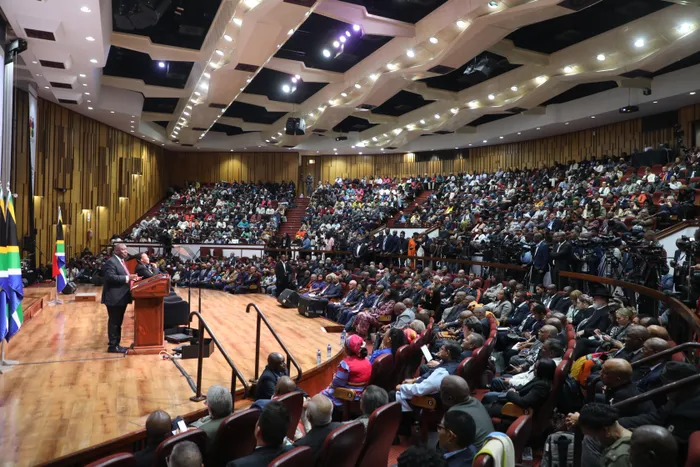
President Cyril Ramaphosa addressing delegates at the national convention, marking the opening of the National Dialogue. Dialogues are often offered as a way for institutional leaders to avoid making controversial statements or taking action during protests. Even with the best intentions, without a genuine commitment to changing culture and practices, these processes can breed distrust.
Image: Oupa Mokoena / Independent Media
NATIONAL dialogues are increasingly recognised as vital tools for resolving political conflicts, fostering state- and nation-building, enhancing social cohesion, and facilitating peaceful socio-economic and political transformation.
Just as our physical muscles need regular exercise, good nutrition, and rest, our civic muscle requires constant care to build a resilient and equitable future. This civic muscle consists not only of programmes, interventions, and policies but also the connections between citizens that bind this muscle to the skeleton of our institutional structures, making them both strong and accountable.
Sadly, civic connection and cohesion have long diminished among South Africans since the euphoric triumph over apartheid. So too have our levels of trust in institutions and our ability to take collective action for the common good. The glue that once held us together has lost its power. The unity that made the apartheid government ungovernable has been replaced by a pervasive sense of despair and hopelessness. The fabric of trust has been shredded.
In a democracy, an electorate’s negative attitude toward government often signals confusion and drift. As a Czech proverb aptly states: “Trust is like a sheet of paper. Once crumpled, it can never be perfectly smoothed again.” This trust deficit, as noted by Sam Crosby, leads voters who distrust the government’s commitment to their interests to turn to non-incumbent or third-party candidates. Political trust is a proxy for political legitimacy, reflecting the level of popular support for the government and its policies.
Dishonesty, corruption, crime, deceit, and maliciousness have infected almost all aspects of South African reality. It is an irrefutable fact that our nation faces some of the most complex and unprecedented challenges in its democratic history. Our disconnections have become increasingly apparent, and many recognise the urgent need to restore strained connections and build new ones where they never existed.
It is against this background that a national dialogue remains a viable way to determine where we went wrong. However, I am opposed to the top-down approach proposed by the government. This dialogue must be conducted in all languages, not just impeccable English and elitism that the upcoming event seems to embody. It should be led by credible civic organisations and individuals with a proven track record of championing the cause of the embittered and downtrodden.
In their article, *Overcoming Polarisation through Local Dialogue and Story-Telling*, Joan Blades and Parisa Parsa posit that shared interests and common purpose can and do exist alongside differences. When we are in a relationship with each other, we often learn that our deep values are aligned and that we merely disagree on the situation or the means to achieve a shared goal. Knowing we agree on a deeper purpose makes it easier to maintain our connections and search for solutions together.
The authors argue that communities are best served by a variety of practices designed to help them connect or reconnect. At the core of these programmes is listening to understand. Setting aside persuasion and judgment to engage in truly curious listening is powerfully transformative. We tend to think of listening as passive, but deep listening is remarkably connective.
Social science confirms that we don’t even truly hear each other until we care about each other. Once we care, everything changes. We move from the likelihood of lose-lose outcomes to the possibility of win-win outcomes. With everyone’s best ideas in the room and the agility that comes with connection, we can begin to address complex challenges more successfully.
Political polarisation has caused people to abandon friendships and even family. Unfortunately, our media and many leaders use polarisation to gain audience and popular support. The us-versus-them tactic is age-old and remains highly effective. News that frightens or angers us is shared more widely, and algorithms highlight this content. While not a panacea, local initiatives are best able to combat this tilt toward division.
Faith communities, school groups, libraries, and individuals must step up to this challenge — a task that is rich, rewarding, and yes, intimidating. My view is that we need a bottom-up approach led by the masses, not a top-down one led by elites with decorated CVs. We need simple dialogue, not a display of ostentatious erudition. In short, the thousands of community organisations that should have been invited to this crucial indaba must be included.
We need community groups that meet monthly or quarterly without the full glare of the media. As Blades and Parsa argue, different communities and challenges are best served by varied practices. For decades, people have worked to connect across differences of ideology and worldview, creating a solid body of literature and practice.
This work has opened hearts and minds and connected people beyond what anyone thought possible. In these fragmented times, where we are funnelled into smaller demographic bubbles, dialogue reminds us of our own complexity and that of others.
The dynamics of polarisation push us to shed our varied and malleable identities and cling fiercely to a single one. This encourages us to ignore the places that yield the most opportunities for growth: where our values conflict, or where we feel torn about our loyalties. Dialogue, where there is time to think, listen, and speak, invites us into those very places where growth, creativity, and new possibilities emerge. It is a beautiful thing to be part of and to witness.
However, not all dialogue is created equal. According to Blades and Parsa, dialogue practices have sometimes earned a reputation for being too soft, manipulative, or ineffective. Too often, the term is applied to any gathering where people talk, like a panel of experts followed by a Q&A. While technically a dialogue, this is far from the mutual understanding, respect, and values-deep conversation we need.
The process has been misused. Dialogues are often offered as a way for institutional leaders to avoid making controversial statements or taking action during protests. Even with the best intentions, without a genuine commitment to changing culture and practices, these processes can breed distrust. Participants, especially those from historically marginalised groups, can leave feeling that they were once again asked to tell their story with no meaningful result.
I share the sentiments of Blades and Parsa, who believe that conversational connection, combined with the power of machine learning and networked possibilities, can offer resources for recovery and resilience as we work toward equitable futures. It begins with the solid habit of dialogue that engages us intimately in making sense of our past while opening space to imagine new futures. The subsequent decisions about where to invest our time, money, and attention make all the difference.
Let’s build the strength for an equitable future, conversation by conversation, together. All sectors of South Africa can be empowered if they join in a national dialogue that embodies a comprehensive vision.
How I wish an increasingly mobilised citizenry could emerge from this dialogue to take bolder stands against social injustice and, most importantly, secure our nation’s future. South Africa has reached a state of political paralysis because the wrong people seem to have taken control of the national conversation. People watch in silence as the underpinnings of our society weaken while competitive nations strengthen.
We must return to a climate of reasoned discussion based on agreed-upon facts, with greater mutual respect and civility, and more openness to consensus and compromise. In this process, each party gains by sacrificing something valuable to the other, and the national status quo is improved for all.
* Dr Vusi Shongwe works in the Department of Sport, Arts, and Culture in KwaZulu-Natal and writes in his personal capacity.
** The views expressed here do not reflect those of the Sunday Independent, IOL, or Independent Media.