

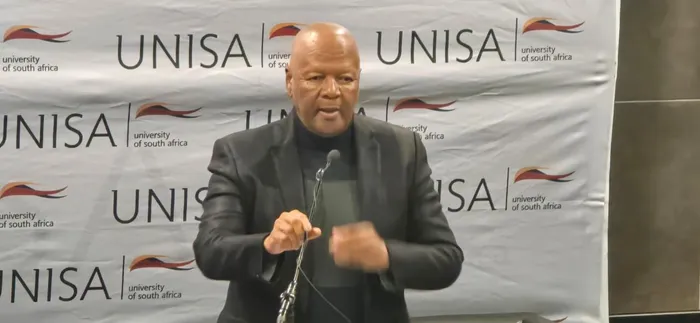
JEFF Radebe, ANC KwaZulu-Natal Provincial Convenor, issued a warning to South Africa’s political landscape, explicitly challenging entrenched power structures, political opponents, and high-profile figures undermining the nation’s constitutional progress.
Image: Sizwe Dlamini/Sunday Independent
JEFF Radebe, ANC KwaZulu-Natal Provincial Convenor, this week, issued a warning to South Africa’s political landscape, explicitly challenging entrenched power structures, political opponents, and high-profile figures undermining the nation’s constitutional progress.
In his Freedom Charter Lecture delivered at Unisa on Thursday, Radebe made a call to resist those seeking to dismantle the gains of decades of struggle for justice, and a clarion for radical reform rooted in the ideals of the Freedom Charter.
“These formations, which mushroomed in the aftermath of the 2024 electoral outcomes, seek to construct a society that is the antithesis of the Freedom Charter,” Radebe said, criticising emerging political entities that “mobilise on the basis of racial exclusion and chauvinism”.
He cautioned that these groups aimed to “reverse the gains of constitutional democracy” and “restore elements of apartheid logic”, particularly “the pursuit of parliamentary supremacy”. “They are building ‘Black Parties’ as a counterweight to the vision of non-racial unity,” he said, calling their actions “an attempt to undo the progress we have made as a nation”.
Radebe’s critique extended beyond domestic politics into foreign policy, where he condemned those “who once spoke for the state”, now supporting actions that threaten South Africa’s dignity. “The position of the Republic of South Africa, not any political party or former official, is the custodian of its foreign policy,” he emphasized. “Silence is not neutrality—it is complicity.
“It is profoundly disturbing,” he continued, “that some within our own country, who once occupied high office and bore the constitutional duty to speak on behalf of the Republic have chosen to undermine our principled foreign policy positions,” especially regarding the ongoing conflict in Western Sahara. “We must state unequivocally: the position of the Republic of South Africa is to reaffirm unwavering solidarity with Western Sahara,” he said, condemning individuals who “support rogue actions that undermine our principled foreign policy positions”.
In his broader internal critique, Radebe condemned what he saw as a betrayal of revolutionary ideals. “Supporters of newly established political parties that vehemently oppose the ideals of the National Democratic Revolution… seek to construct a society that is the antithesis of the Freedom Charter,” he said. “They attempt to reverse the gains we fought so hard for, and we must resist with every ounce of our revolutionary spirit.”
He made it clear that these political moves threatened “the democratic, non-racial, and inclusive future envisioned by the Charter”, and cautioned that, if these trends were not stopped, “we risk turning back the clock to worse than apartheid”.
Recalling the revolutionary origins of the Freedom Charter, Radebe stated: “The Charter was born from the collective dreams and demands of ordinary South Africans. It was adopted by the people, and only later endorsed by the ANC as policy. That endorsement marked a major ideological shift: from resistance to reconstruction, from protest to programme.
“It is vital to remember that the Freedom Charter was not initially an ANC document. It was adopted by the people,” he reiterated, underscoring its grassroots origins and moral authority. “It remains the moral compass of our post-apartheid state… these principles continue to guide us in our efforts toward justice and equality.”
Shifting his focus to governance, Radebe took a sobering stance on systemic failures across the country. “Over 90% of our municipalities are financially distressed or failing,” he noted, describing the situation as “systemic decay”.
“In too many towns, water has not flowed in months, electricity is unreliable… and waste goes uncollected. These are not isolated failures; they signal systemic decay.” He warned that: “When local government fails, it is not simply a service failure — it is a breach of the Constitution. The collapse of local government is the collapse of legitimacy,” he emphasised, framing current shortcomings as a betrayal of revolutionary principles of service and justice.
In economic terms, Radebe denounced the ongoing inequality entrenched by the legacy of apartheid. “Wealth is still largely controlled by those who benefited under apartheid,” he said, condemning the continued influence of “corruption, elite capture, and institutional failure”.
He highlighted the plight of skilled professionals, noting: “South African pilots, among the most skilled professionals in our society, must plead for fair wages from foreign shareholders who extract profits from our skies but invest little in our country.”
He also slammed the devastating impact of illicit financial flows (IFFs), which “bleed our continent and our country dry to the tune of R80 billion to R100bn annually,” according to estimates. “These flows are orchestrated theft from the public purse. IFFs are acts of betrayal against the developmental aspirations of our people.
“We must adopt a binding anti-IFF strategy, strengthen the Financial Intelligence Centre (FIC), criminalise corporate tax avoidance, enhance cross-border transparency, and repatriate stolen assets through multilateral partnerships. It is not anti-business to demand accountability; it is pro-development.”
The speech also addressed systemic inequalities and inefficiencies in public service, citing the 2024 Auditor-General’s report, which revealed that “more than 90% of our municipalities are in distress or failing”, with water not flowing in months and waste uncollected. “These failures are a breach of the Constitution,” Radebe said. “Local government is the frontline of our democracy… its failure is a failure of the social contract.”
He called for a new, inclusive national dialogue — “a modern-day Kliptown” — to reshape South Africa’s future based on participation and collective ownership. “This dialogue must not be a technocratic conference for the privileged few. It must be a radical forum where the people speak and shape the future… much like the process that led to the Freedom Charter, the dialogue must reflect the radical democratic spirit of collective authorship, not elite consensus.”
Radebe urged the South African youth to lead this effort: “Today’s youth must lead in reimagining these frontiers of freedom… They must not be left behind but be the drivers of our future.”
In closing, Radebe advised: “Democracy is not inherited; it is built, and rebuilt, by every generation that refuses to accept injustice as normal.” He reaffirmed his commitment to lifelong resistance to corruption and inequality, and warned: “If we fail to confront this fiscal injustice, we surrender the economic sovereignty that our freedom demands.”
His words serve both as a warning and an appeal: “The time has come for us to choose: Will we allow the Freedom Charter’s dream to fade into history, or will we seize it anew and forge a Just and free South Africa?”