

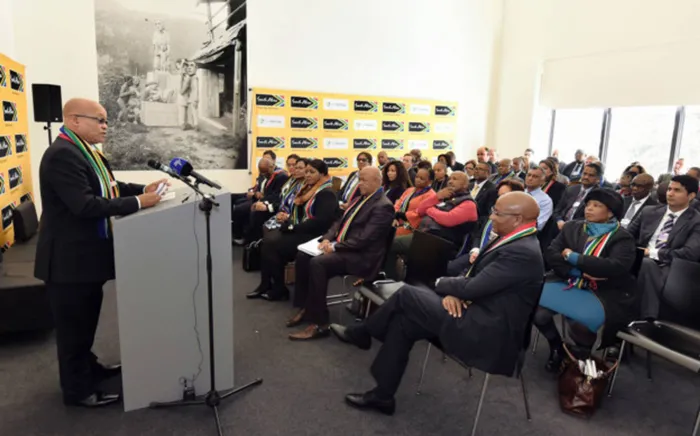
President Jacob Zuma addressing Team SA on the margins of the WEF 2016 Annual Meeting in Davos, Switzerland. 21/01/2016, Elmond Jiyane, GCIS President Jacob Zuma addressing Team SA on the margins of the WEF 2016 Annual Meeting in Davos, Switzerland. 21/01/2016, Elmond Jiyane, GCIS
Yunus Kemp
DAVOS: The global economic crisis and major advances in technology should be tackled head-on by a cohesive African response, driven by the African Union, says President Jacob Zuma.
He intends using the 26th AU Summit to strongly lobby for a self-reliant continent unshackled from its colonialist links.
The summit opened in Addis Ababa on Wednesday and Zuma, currently in Davos to attend the World Economic Forum’s annual meeting, is due to attend next week.
“I will be presenting this to the AU next week,” Zuma told a gathering of cabinet ministers and business people hosted by Proudly South Africa in the Kirschner Library in Davos yesterday.
“The AU has gravitated towards looking at the interests of the continent collectively, which was not the case 20 years ago, (due to) pressure from colonialists.”
He pointed out that infrastructure was crucial in connecting the different economic power blocs in Africa, of which there were five.
“Three have signed agreements, while discussions with the other two are ongoing.”
He said this pointed to a continent growing ever more aware of the importance of economic co-operation, given the turmoil in the global economy.
“We need an integrated approach to look at the African economy.
We are getting constant updates on economies of Africa. These issues will be raised at |the AU.”
With regards to the WEF theme – the Fourth Industrial Revolution – Zuma questioned if any real solutions had come out of last year’s gathering.
He questioned if constructs like the WEF held any real quantifiable value for the continent. “We had a theme last year on the growing gap between rich and poor. Twelve months later and now we are doing something else. Why are we not talking and dealing with this widening gap and the inequality that exists?”
The WEF estimates that by 2020, “the Fourth Industrial Revolution will have brought us advanced robotics and autonomous transport, artificial intelligence and machine learning, advanced materials, biotechnology and genomics”.
Zuma and other African leaders have questioned how African countries can use |this technological paradigm shift to be part of the advancement, opposed to settling |to be mere late adopters or bystanders.
“How do we use current technology to help solve challenges. How do we shape the Fourth Industrial Revolution and influence it in our favour. What are we doing to catch up.
“This is the debate we need to have in Africa.”
Zuma said Africa needed to harmonise an understanding that “we are part of this |revolution”. Earlier, in his scripted speech, Zuma said South Africa had a strong showing in Davos each year.
“That is because of the unity of purpose of the South African delegation. We come here very clear about what we are coming to achieve. We come here each year to tell the story of our beautiful country and its successes.”
This year’s meeting happens in yet another difficult time in the global economic environment, he said.
“Fears of a slowdown in China are fuelling concerns about global growth prospects. Lower commodity prices have also seen prospects of economic recovery in developing countries fade. The cloud of uncertainty has resulted in volatility in capital markets. This has also put severe strain on investments in developing economies.
“Despite a very unfavoura-ble economic backdrop, the South African economy has been very resilient.”
Zuma said South Africa’s participation in the forum was underpinned by clear objectives. “We want to raise the level of foreign investment in our country. Therefore, our message remains clear. South Africa is open for business.”
Some of the business delegates told Zuma that confidence was key for South Africa to encourage investment, and that we should celebrate what have proven to be effective economic drivers.
Nepad (New Partnership for Africa’s Development) pointed out that because the infrastructure deficit in Africa penalised growth and development, in July 2010 African leaders launched the new Programme for Infrastructure Development in Africa (Pida).
Led by the AU, Nepad and African Development Bank, the initiative has a budget of several billion dollars.
The overall goal is to promote socio-economic development and poverty reduction |in Africa through improved access to integrated regional and continental infrastructure networks and services.