

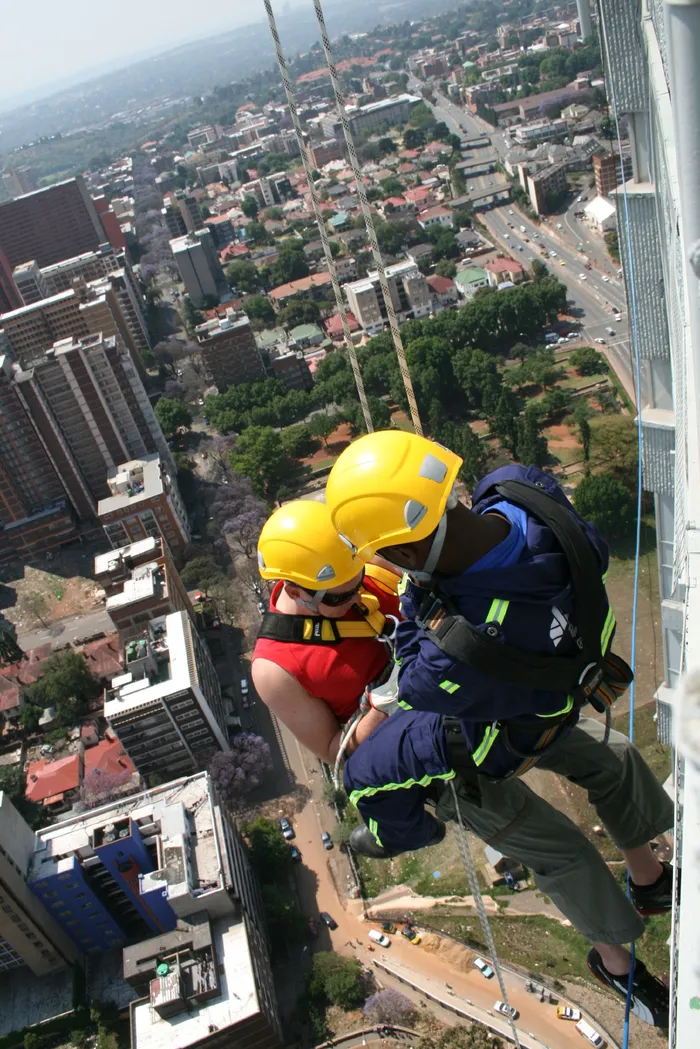
ST Abseiling ponte Johannesburg’s evolution into a modern African metropolis demands infrastructure that can meet the pressures of growth, climate change, and urban complexity.
Image: Annie Mpalume
Deteriorating infrastructure, unsafe public spaces and limited access to basic services characterised many Johannesburg neighbourhoods 25 years ago.
25 year transformation
However today, the Johannesburg Development Agency (JDA), the infrastructure development arm of the City of Johannesburg(CoJ) says its precinct-based approach is actively reversing this legacy.
Through integrated infrastructure delivery, the Agency continues to create safer, more accessible, and dignified urban environments-particularly in communities that were historically underserved, says the JDA's spokesperson Kenneth Nxumalo in a statement.
He says projects such as the Elias Motsoaledi Gravel Roads Project reflect this transformation in action. “What were once marginalised spaces are being reshaped into functional neighbourhoods with improved public areas, better access to services and enhanced liveability, directly contributing to quality-of-life improvements for residents.”
The CoJ's infrastructure development arm of the City of Johannesburg, is commemorating its 25th anniversary under the theme “25 Years of Urban Transformation.”
It says this milestone marks a quarter-century of strategic city-building-transforming Johannesburg from a city shaped by fragmented planning and uneven development into one increasingly defined by connected, inclusive and people-centred urban spaces.
“As the JDA reflects on its 25-year journey, it also celebrates the achievements of its 24th year of operation-a year that demonstrated how focused infrastructure investment continues to reshape the city’s spatial form, unlock opportunity and to improve everyday life for residents.”
Revitalising Joburg's heritage - rebuilding the city’s future
Urban transformation is not only about new development-it is also about restoring the city’s civic heart, the JDA says. Over 25 years, the JDA has played a critical role in preventing the decline of key public assets and reimagining them for contemporary use, it adds.
“The renovation of the Johannesburg City Library is a powerful symbol of this philosophy. By restoring this landmark institution, the JDA is ensuring that Johannesburg’s heritage infrastructure continues to serve as a vibrant, accessible centre for learning, culture and social connection - bridging the city’s past with its future.”
Modern infrastructure for a growing city
The agency says Johannesburg’s evolution into a modern African metropolis demands infrastructure that can meet the pressures of growth, climate change and urban complexity. It says that in its 24th year, the JDA advanced projects that strengthen the city’s capacity to respond to these challenges.
“The development of facilities such as the Central Fire Station exemplifies how new infrastructure investment directly enhances service delivery, public safety,and urban resilience. These projects are not isolated interventions-they are part of a broader vision to future-proof the city and improve how residents experience municipal services every day.”
Renewing community assets through thoughtful upgrading
Urban regeneration is as much about renewing existing assets as it is about constructing new ones, says the JDA. It says over the past year, it has continued to modernise vital community infrastructure to meet contemporary standards and community needs.
“The revitalisation of the Chris Hani Sports Complex demonstrates how targeted upgrades can reinvigorate public facilities-creating inclusive spaces that promote health, recreation, youth development, and social cohesion, while restoring community pride in shared assets.”
Infrastructure:an engine for economic opportunity
From its inception, the JDA says it has understood infrastructure as a powerful catalyst for economic inclusion. It adds that over 25 years, this approach has helped stimulate local economies, create employment, and support small businesses across the city.
“The rollout of Rea Vaya Phase 1C during the Agency’s 24th year is a clear example of this impact. Beyond improving mobility, the project has empowered local communities through job creation, SMME participation, and the meaningful integration of taxi operators into the formal public transport system. This model of development ensures that economic benefits are embedded within the communities where infrastructure is delivered.”
Growing sustainable urban spaces
As Johannesburg grapples with environmental pressures, sustainability has become central to the JDA’s work, says Nxumalo. He says over the years, the Agency has increasingly embedded green infrastructure and environmentally responsible design into its projects.
“Initiatives such as Drieziek Recreation Park illustrate this shift-transforming underutilised land into high-quality green public spaces that improve environmental conditions while offering residents safe, recreational amenities. These projects signal a move toward a more climate-resilient and liveable city.”
The JDA says by marking 25 years of operation, the progress achieved in its most recent year stands as a testament to the Agency’s enduring mandate: to transform Johannesburg through strategic, inclusive infrastructure development.
It says what was once a city marked by spatial inequality and neglected public spaces is increasingly becoming a city of renewed precincts, revitalised institutions, and growing opportunity.
It adds that this anniversary is not only a celebration of past achievements-it is a reaffirmation of purpose. “The JDA remains committed to building infrastructure that transforms lives, strengthens communities, and delivers a more inclusive, connected, and resilient Johannesburg for generations to come.”
In giving practical expression to their commitment, Nxumalo said the JDA on behalf of the City of Johannesburg, continues to implement targeted urban development initiatives that both honour the country’s liberation history and improve the quality of life for residents, workers, and visitors to the city.
Two key projects currently underway in the inner city include the Chancellor House Refurbishment Project and the High Court Precinct Public Environment Upgrade (PEU) which is said to stand as important interventions linking Johannesburg’s built environment directly to the ideals of justice, human dignity and human rights.
The scope of work includes the removal of deteriorated elements, structural crack stitching, drywall installation, roof waterproofing and upgrades to plumbing and electrical systems. Ironmongery works and testing of existing mechanical and electrical services also form part of the intervention.
In parallel with preserving historic sites of struggle, the JDA said it was implementing the High Court Precinct Public Environment Upgrade (PEU) - a project focused on reshaping the space surrounding the Gauteng Local Division of the High Court into a safer, more accessible, and dignified civic environment.
Bounded by Lillian Ngoyi, Delvers, Helen Joseph and Eloff Streets, the precinct plays a vital role in Johannesburg’s judicial landscape and supports a dynamic mix of commercial activity, residential life, retail trade and informal economic participation.
Speaking during the official opening of Fedsure House in 2024, a property refurbishment project undertaken by Samuel Beyin, the CEO of Focus1 student accommodation and a long-standing TUHF client, Paul Jackson, CEO of TUHF, said Johannesburg’s inner-city is a truly African city and a place of inclusion, economic growth and opportunity.
Located at 13 Plein Street in Johannesburg’s CBD, Fedsure House is a state-of-the-art student accommodation facility.
The project was described as demonstrating the potential of Johannesburg’s inner-city to be inclusive for its residents and profitable for investors who, like Beyin and TUHF, saw what others do not and remained committed to urban regeneration.