

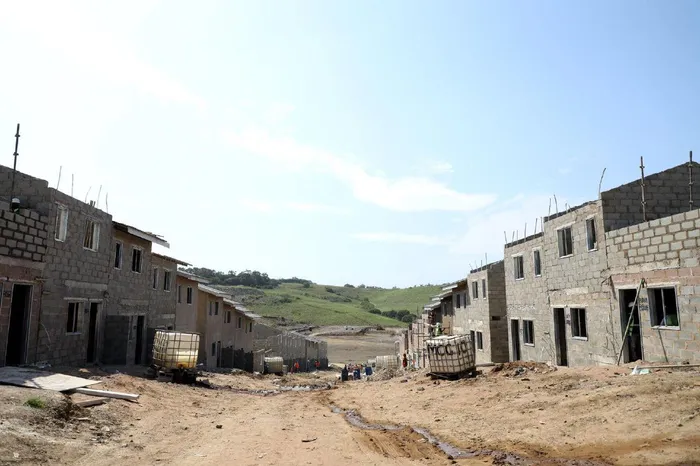
The greater challenges for the property market and industry are homegrown, in the form of an economy hardly growing, unemployment being high and many households not housed in formal housing.
Image: Supplied
There are several reasons for the South African Reserve Bank (SARB) to consider a lowering of the repo rate tomorrow.
This has become overdue against the background of lethargic economic growth and rising unemployment, says Dr Roelof Botha, an economic advisor to the Optimum Investment Group.
“In fact, the MPC missed an opportunity in January to soften the plight of South African households that are faced with a significantly higher cost of credit than most of our key trading partners,” Botha says.
SARB will deliver this year’s second interest rate decision on Thursday afternoon.
The SARB hosts a media briefing every two months to release its Monetary Policy Committee (MPC) statement, following the meeting of the MPC. The SARB fulfils its constitutional mandate to protect the value of the rand by keeping inflation low and steady.
The basic aim of monetary policy is to determine how much money an economy should have in circulation.
Botha says that apart from the fact that almost half of the country’s labour force cannot find employment, other reasons for a dire need to lower interest rates include the following:
The Reserve Bank will keep interest rates unchanged on Thursday, says independent economist John Loos. He says while some people may point to the February Consumer Price Inflation (CPI) figure of 3% as being a reason to cut interest rates, given that the SARB’s target is 3%, the February CPI number was surveyed well before the onset of the latest Middle East conflict around Iran.
“That conflict has changed a lot in the world, with oil prices having risen significantly, and fertiliser prices for agriculture also likely to experience upward pressure due to a large part of the world's supply having to be shipped through the highly contested Strait of Hormuz.
"With petrol prices likely to experience an extreme rise in April, which will feed into the CPI of that month, and given that the Reserve Bank is forward-looking in its inflation targeting, it will focus on the inflationary risks that have emerged in March due to the onset of the Middle East conflict.
"These risks, I believe, will persuade the bank to adopt a wait-and-see approach, and leave rates unchanged for the time being.”
While the oil price spike and speculation of a higher petrol price are putting upward pressure, this volatility due to the Middle-Eastern war must be seen as temporary rather than a reason for a premature rate hike, said Samuel Seeff, chairman of the Seeff Property Group, earlier this week.
The real estate agency argued that the underlying fundamentals for keeping the rate unchanged remain strong. It said the Rand has remained fairly stable below ZAR17 to the USD.
“Inflation is contained within the Bank’s new target range, and in fact dipped to 3.0% for February (from 3.5% in January and 3.6% in December), clearly suggesting there is no fundamental reason for a rate hike.”
Loos says that an unchanged interest rate decision, which will be the second consecutive unchanged decision should it happen, will cause growth rates in new mortgage loans to slow, as well as for house price growth rates to slow after likely having peaked early this year.
Slowdown in such growth rates would be due to a lack of further interest rate cutting stimulus since November, he adds.
The independent economist says South Africa could also see growth rates in durable consumer goods, which include vehicle sales, slow noticeably, with this category of consumer goods being most highly credit-driven and therefore sensitive to interest rates.
He says that typically, the growth rates in this category of consumption start to slow quite quickly when interest rate cutting slows or ends.
“I still believe it is possible that real economic growth may grow slightly faster than the 1.1% of 2025, with the lagged impact of last year's interest rate cutting still to feed through into coincident and lagging sectors of the economy.
"But this is based on the assumption that the conflict in the Middle East is fairly short-lived, and that the Reserve Bank does not have to resort to any interest rate hiking this year.”
Loos says that, given the uncertainty in the global environment, an unchanged interest rate decision would be the best option to take. He says the SARB needs to retain its credibility about inflation targeting, and it cannot ignore the global inflation risks currently present.
He adds that while a lack of further interest rate cutting this year is likely to see slower growth in new mortgage lending and house prices, maintaining price stability and containing consumer growth spending at a risky time like the present can be positive for longer-term property market stability.
“I would say that in general the Reserve Bank’s function is more to maintain macroeconomic stability, i.e., a risk management role, as opposed to fuelling short-term economic growth regardless of stability risks.”
The independent economist says he does not think that the property sector is contending with a severe economic environment just yet.
Loos says much will depend on how long the Gulf conflict continues and whether oil prices go significantly higher. He says that, however, the greater challenges for the property market and industry are homegrown, in the form of an economy hardly growing, high unemployment, and many households not housed in formal housing.
“But the support for this has to largely come in the form of policies aimed at a far higher economic growth rate and employment growth rate, enabling far more households to be able to afford housing. Oil shocks will come and go, but the need for structural reform in the South African economy is the big issue for property,” says Loos.
Over the past decade, Botha says it has become apparent that the MPC’s policy focus has been concentrated on the lowering of inflation, with a disregard for the second element, namely, to conduct policy in the interests of balanced and sustainable economic growth (as per its Constitutional mandate).
“These words were echoed by Prof Joseph Stiglitz, a Nobel laureate in Economics, during a recent visit to South Africa, when he stated that there is an absolute necessity for deep interest rate cuts for the national economy to thwart an impending recession.
"South Africa's reliance on inflation targeting can be problematic given its high levels of unemployment and the impact of a strong exchange rate on its competitiveness.”
Independent Media Property