

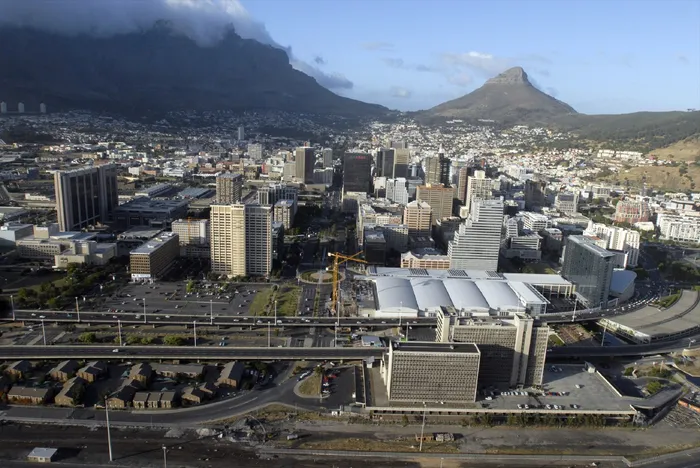
The City of Cape Town has stated its commitment to continue offering properties for sale or lease through auctions. This will be done only after a thorough internal review confirms that the properties are not required for municipal purposes and, as they become available.
Image: Donna Ingram
While central business districts (CBDs) used to be areas primarily focused on commercial uses, this is changing globally.
The long-term objective of a city should be the creation of a built environment that meets the requirements of different income and age groups, says associate professor Francois Viruly, of the Department of Construction Economics & Management at the University of Cape Town (UCT).
“In the future, CBDs will be places offering a broader mixed-use experience which combines home, work and play. The sale of land by the city provides an opportunity to achieve this,” Viruly says.
Earlier this week, the City of Cape Town said in a media statement that the release of the iconic Good Hope Centre precinct for redevelopment is a strategic move aimed at unlocking its immense economic potential, revitalising the broader precinct, and leveraging private-sector investment to boost job creation and economic growth to benefit Cape Town residents.
“By releasing this site for revitalisation and redevelopment, we are giving the private sector the opportunity to develop a vibrant mixed-use precinct.
"Heritage elements, including the dome, are preserved through the conditions of sale, while the surrounding land can be transformed into multiple uses, unlocking significant economic and spatial value for the inner city,’ said Alderman James Vos, Mayoral Committee Member for Economic Growth.”
The key verified development information for investor due diligence includes:
These parameters provide a clear foundation for feasibility modelling and redevelopment planning.
A wide range of opportunities across multiple investment categories and strategic growth areas will be available for sale and lease:
In total, about 282 000m² of land will be released, creating diverse entry points for developers with varying investment profiles, from mixed‑use precincts to industrial expansion and urban infill housing.
The decision follows the City’s disposal processes, in which properties are reviewed to determine whether they are still needed for municipal operations/ purposes.
Where land is confirmed as surplus, it is released to the market. As such, it:
“Cape Town is a city full of opportunity, and as custodians of its assets, it is the city’s responsibility to ensure that municipal land and buildings contribute to the city’s growth and the well-being of its residents.
“This upcoming auction is a sterling opportunity for private-sector investment across the metro, with each site being carefully packaged to attract capable investors ready to deliver tangible benefits for communities and the broader economy,” says Vos.
The decision by the city to auction land is welcome and starts opening possibilities to deliver social and affordable housing close to and in the CBD, says Viruly.
He says that with well-located land being in short supply, it is critical that land is appropriately used from a social and economic perspective.
“The aim should be to ensure that the CBD caters for different income groups, in particular those working in the CBD. It is important that these auctions take place with a strong emphasis on meeting social objectives instead of securing the highest possible economic value for the land,” he says.
The professor says the decision to make land available for development should form a critical component of a pro- housing policy. “Apart from delivering on housing, developments also have a role to play in promoting local economic development and employment opportunities. And in the process, it increases that rate base.”
The release of city-owned land is a fantastic opportunity to take assets that are not being utilised and sell them for greater development to the benefit of the city as a whole, says Samuel Seeff, chairman of the Seeff Property Group.
He says it provides employment, greater opportunities, and business opportunities. “It also allows property developers to take over properties which are basically standing empty, unused, and not adding any value.
"The city can now auction them off, let them be developed, and unlock benefits, the employment that goes with it, the businesses can go with it, the rates and taxes, etc., that will follow.”
It’s a win-win, says the property group. “The City should have done this years ago.”
The city says it last held a successful auction in May last year, which included prime Kraaifontein industrial land.
The city will continue to release properties for sale or leasing via auctions when they become available, and only after undergoing a thorough internal process confirming they are not required for municipal purposes, says Vos.
“Cape Town is a city of opportunity. As custodians of public assets, the City must ensure that municipal land and buildings actively, meaningfully and optimally contribute and support growth, economic inclusion, job creation, and improved service delivery and overall, improve the well-being of its residents.”
Independent Media Property