

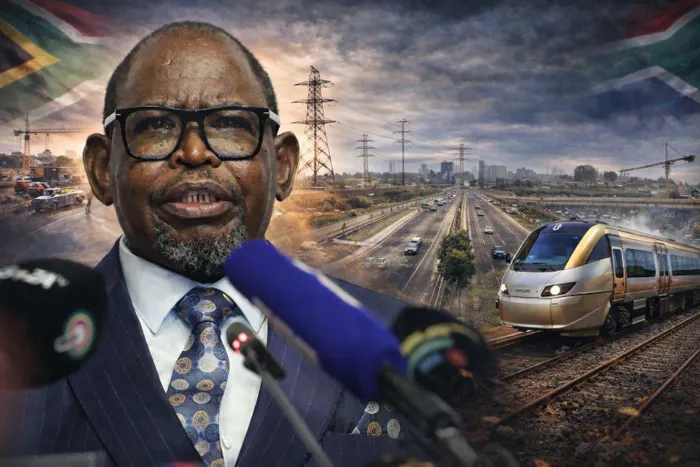
Finance Minister Enoch Godongwana described infrastructure investment as central to long-term economic growth, job creation, and improved service delivery.
Image: AI / ChatGPT
Government will spend more than R1 trillion on public infrastructure over the medium term as it shifts expenditure towards growth-enhancing investment, Finance Minister Enoch Godongwana said during his National Budget Speech on Wednesday.
This follows President Cyril Ramaphosa’s comments in the State of the Nation Address earlier this month, in which he said government was implementing a R1 trillion public infrastructure commitment over the next few years.
The President characterised the allocation – the largest in the country's history – as more than just brick and mortar. Instead, it is a “transformative” investment aimed at reversing years of declining fixed investment and stagnant growth.
“Through the Infrastructure Fund and new regulations for public-private partnerships, we are using innovative funding models, reducing risk and attracting investors to fast-track projects in energy, water, transport and digital infrastructure,” he said.
Godongwana described infrastructure investment as central to long-term economic growth, job creation, and improved service delivery.
Of the planned spend, R577.4 billion will come from state-owned companies and public entities, R217.8 billion from provinces, and R205.7 billion from municipalities.
Transport and logistics account for the largest share of allocations, followed by water and energy.
The South African National Roads Agency Limited will focus on strengthening network resilience, including maintenance of about 27,000 kilometres of roads and resurfacing of 2,000 kilometres annually.
The Passenger Rail Agency of South Africa will continue its corridor recovery programme and rail modernisation drive as Treasury expects annual passenger trips to increase from 77 million in 2024/25 to between 250 million and 450 million over the medium term.
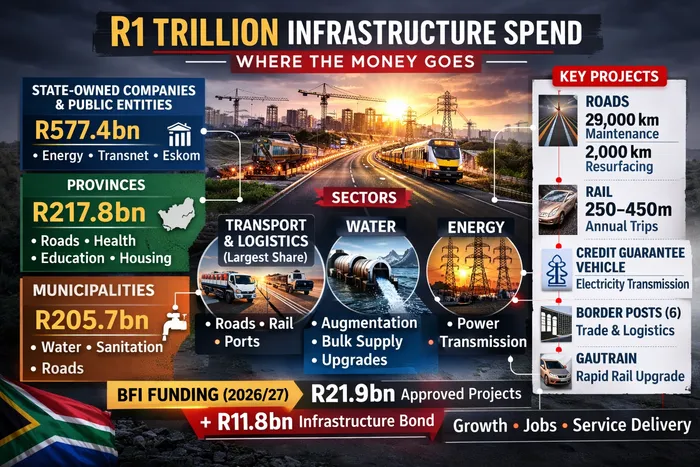
Government will spend more than R1 trillion on public infrastructure over the medium term as it shifts expenditure towards growth-enhancing investment.
Image: ChatGPT
In energy, investment will prioritise security of supply and crowding in private-sector participation.
Godongwana said National Treasury and the World Bank are making progress on the Credit Guarantee Vehicle, aimed at unlocking large-scale investment in electricity transmission infrastructure.
The vehicle is expected to be incorporated as a company in the coming months and will be operational later this year following its approval of a licence by the Prudential Authority.
Water-sector spending will target bulk augmentation schemes, refurbishment of ageing systems, and completion of strategic projects supporting households, agriculture, and economic hubs.
Treasury said reforms to public-private partnership regulations are helping accelerate project pipelines and shorten delivery timelines. Sixty-three public-private partnership projects are currently in development.
Among the most advanced are six border post upgrades expected to reach financial closure later this year, alongside the procurement of a new vendor for the Gautrain rapid rail link.
Treasury said successful completion would mark the first closure of major public-private partnership transactions in more than five years.
The Budget Facility for Infrastructure has approved R21.9 billion for five strategic projects since moving to quarterly application windows.
These include Transnet’s coal and iron ore corridor upgrades and the Polokwane regional wastewater programme.
Government also issued an infrastructure bond in 2025, raising R11.8 billion to support facility-approved projects. Ramaphosa said that the bond was more than two times oversubscribed.
Godongwana encouraged public institutions in key sectors of the economy to submit proposals with funding gaps and strategic value, for consideration for critical social infrastructure such as courts, correctional facilities, police stations, health facilities, and even the development of new tertiary institutions.
IOL BUSINESS