

Tax on alcohol typically goes up at 6% per year.
Image: Freepik
Government excise tax on spirits is poised to exceed the R100 per 750ml bottle level if Finance Minister Enoch Godongwana applies the customary above-inflation increase in duties during next week’s Budget Speech.
In the May 2025 Budget, National Treasury raised excise duties on alcoholic beverages by 6.75%, continuing a pattern of annual increases that have steadily lifted the tax burden on drinkers. The adjustment, which took effect from April 1, added to the cost of beer, wine and spirits, while traditional African beer was left unchanged.
For spirits producers, the trajectory of increases has become a focal point ahead of the 2026 Budget.
750ml remains the dominant unit size across all major spirits subcategories, including brandy, gin, vodka, whisky and rum.
“At R100 per bottle, government tax becomes the biggest component of the cost to the consumer, ranging between 55% to 65% of the retail selling price of mainstream spirits products. We believe there is no room for consumers to absorb further increases in the statutory component of the price,” said Sibani Mngadi.
Mngadi is the corporate relations director at Diageo South Africa.
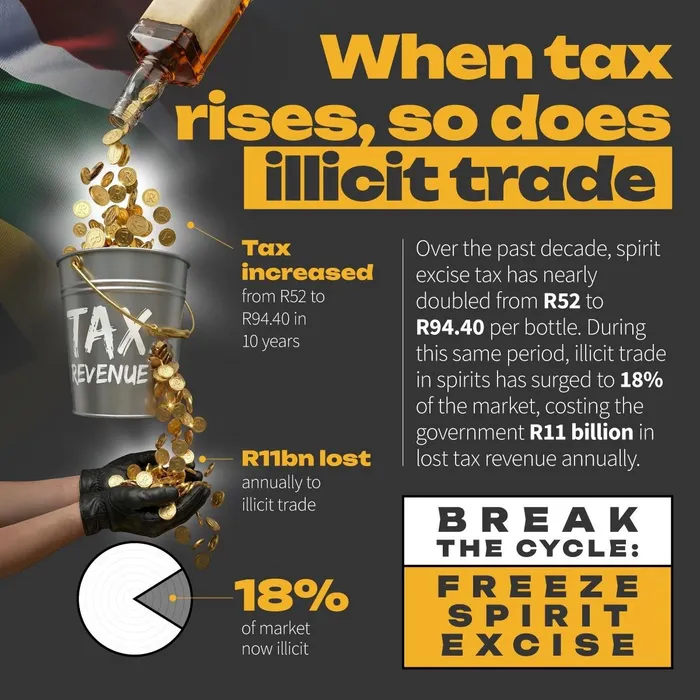
Excise duties on spirits have nearly doubled over the past decade. Industry data shows the tax burden rising from roughly R52 per bottle in 2016 to a projected level above R100 should another increase be implemented.
The company warned that sustained tax hikes are contributing to the expansion of the illicit alcohol trade.
Tax on 750ml bottles of booze could go over R100 a bottle.
Image: Diageo
Tax-evading traders exploit price gaps created by excise increases, offering smuggled and counterfeit spirits at less than half the price of legitimate products. Illicit trade now accounts for an estimated 18% of the total alcohol market, with spirits the most heavily targeted category.
Illicit trade in spirits results in an estimated R11 billion loss in tax revenue annually, according to a 2025 Euromonitor study cited by the industry.
The volume of illicit alcohol rose by roughly 55% since 2017, reaching around 773,000 hectolitres in 2024, the latest available figures. This translates to nearly one in five alcoholic drinks consumed in South Africa being sourced on the black market.
This amount of booze is enough to fill around 1,600 average-sized pools.
From a fiscal perspective, the growth of illegal alcohol represents a major loss to the National Treasury, based on Euromonitor International’s study.
Diageo South Africa has called for a freeze on further excise increases on spirits while National Treasury’s excise tax policy review remains underway.
In its policy review document on the taxation of alcoholic beverages in 2024, Treasury acknowledged that spirits are taxed more heavily than other alcohol categories. The review concluded that, for now, no additional adjustments were proposed for the spirits category.
Mngadi said a consistent taxation approach should apply across beverage types.
“If the excise tax is intended to moderate the overall volume consumption of alcohol in the population, a similar rate per litre of absolute alcohol should apply, irrespective of whether that alcohol is from a distilled or fermented alcoholic beverage,” said Mngadi.
Diageo South Africa said it remains committed to engaging with government and industry stakeholders on an evidence-based excise framework aimed at supporting responsible consumption, curbing illicit trade and safeguarding tax revenues.
IOL BUSINESS