

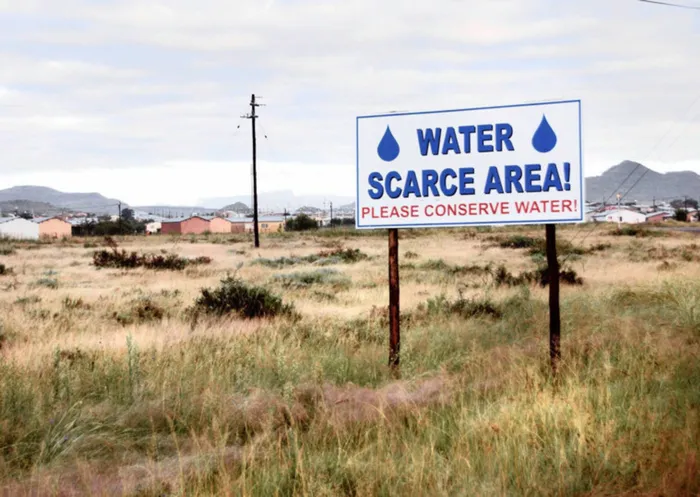
Commercial farms may have their water rights reduced under new plans by the government. At present they have guaranteed access to 62 percent of South Africa's ground water supply, which Environmental and Water Affairs Minister Edna Molewa believes limits growth in mining and industry. Photo: Heather Dugmore. Commercial farms may have their water rights reduced under new plans by the government. At present they have guaranteed access to 62 percent of South Africa's ground water supply, which Environmental and Water Affairs Minister Edna Molewa believes limits growth in mining and industry. Photo: Heather Dugmore.
White commercial farmers – who make up the bulk of the country’s 37 000 commercial farmers – believe they are under attack from two government ministries: water and rural development.
The industry has reacted with concern to government plans to restrict the water supplies of commercial farms and to force what it believes are unworkable equity arrangements on agricultural operations by Rural Development and Land Reform Minister Gugile Nkwinti.
Environment and Water Affairs Minister Edna Molewa said farmers were not necessarily using their resources productively.
She was also uncomfortable with the 62 percent guaranteed supply of the country’s surface water to the agricultural sector, which she said constrained the growth of mining and industry. Farmers who did not use their supply would in future lose their excess, she warned. Steps are also in the pipeline to stop the trading of excess water by existing water rights holders, such as farmers.
Agricultural Business Chamber chief executive John Purchase put it bluntly: “I think they [commercial farmers] are under attack.”
Part of the plan by Nkwinti’s department is to require commercial farms to provide equity deals for “disciplined” workers. Such a worker who serves in the field for 10 years would be “entitled to 10 percent share-equity on the land, based on its market value”.
A draft policy paper also proposes that after 25 years “of disciplined service” the farm worker or dweller “shall be entitled to 25 percent share equity of ownership of the land”.
Frans van Wyk, an independent agricultural economist who brokered some of the farm equity deals in the Western Cape while at PwC, said these schemes were hard to implement. He could think of only about five commercial operations that had successful equity schemes.
While the national and the Western Cape governments spoke about 80 equity projects, he believed that there was a thicket of problems associated with many of the schemes as the farm workers were not skilled in their financial and fiduciary responsibilities.
In the context of the Western Cape experiments largely failing, Van Wyk suggested that the new proposal was deeply ambitious. There was also the issue of funding of farm workers in the equity schemes. He said the system simply did not work unless there was private funding and the transactions were paid for “at an open market value”.
Equity deals were proving unworkable for a variety of reasons including that farm workers who decided to leave after, for example, five years would demand a payout for their equity share. Yet many farms would be unable to do so without selling off the farm.
Annelize Crosby, the AgriSA parliamentary representative on law and land issues, said she would not go so far as to say that commercial farming was under attack, but she said policy draft positions and statements were creating a climate “of uncertainty”, which was bad for investment.
Pointing to what Deputy Agriculture Minister Pieter Mulder calls the application of “resource nationalisation” of water through the proposed measures to impose state control and allocation of water rights in future, Crosby said farmers who wanted to expand their irrigation activities would be put off by the news.
It was frightfully expensive to expand irrigation for fruit trees, for example. There were the costs of the trees, the preparation of the soil, the fertiliser and the planning for a return over “a number of years”. If there was doubt about the water supply, farmers would simply not invest in expansion, Crosby said.
She said AgriSA was also concerned about the equity plans “given that there are two policies in place already”. These included the AgriBEE codes and the existing farming equity schemes, where workers are subsidised by the state to the tune of about R25 000 for shares in a farming operation.
Afrikaanse Handelsinstituut chief executive Christo van der Rheede said the continued accusations levelled at commercial farmers of monopolising water “has little substance”. In practice commercial farmers were “acutely aware that water is a scarce resource”.
They often walked “the extra mile to put infrastructure in place to ensure that water is equitably distributed. For that they must be praised not bashed,” he said.
He suggested that the government as custodian already of the nation’s water had failed to properly implement existing legislation, including the National Water Act.
Van der Rheede, however, welcomed an initiative to hand equity to farm workers “but farmers should in collaboration with workers come up with a workable scheme”. Productive and loyal farm workers were an asset to any farmer.
He suggested a possible tax incentive for equity ventures.